Wa Alaikum Assalam wa Rahmatullahi wabarakatuh Meaning & Arabic Text

The phrase “Wa Alaikum Salaam” serves as the standard response to the greeting “As Salamu Alaykum” in Islamic culture. This greeting exchange, which translates to “Peace be upon you,” is a key aspect of Islamic etiquette and signifies a mutual wish for peace.

It goes beyond a simple acknowledgment of someone’s presence; it is a spiritual exchange rooted in the desire for safety, peace, and blessings from Allah.

In this article, we will explain the full response, “Wa Alaikum Salaam wa Rahmatullahi wa Barakatuh,” its meaning, the correct Arabic text, and pronunciation. Additionally, we will explore the significance of this greeting in Islamic tradition and the appropriate way to respond.

Wa Alaikum Assalam wa Rahmatullahi wabarakatuh in Arabic Text

In Arabic, the full phrase is written as follows:

وَعَلَيْكُمُ ٱلسَّلَامُ وَرَحْمَةُ ٱللَّٰهِ وَبَرَكَاتُهُ

This phrase is used as a formal reply to “As-Salamu Alaykum” and is commonly exchanged between Muslims during daily encounters, prayers, and formal gatherings. Its full form carries a deeper expression of goodwill and divine mercy.

Meaning of Wa Alaikum Salaam wa Rahmatullahi wa Barakatuh in English

The literal translation of “Wa Alaikum Salaam wa Rahmatullahi wa Barakatuh” is:

  • Wa Alaikum Salaam (وَعَلَيْكُمُ ٱلسَّلَامُ): “And upon you be peace.”
  • Wa Rahmatullahi (وَرَحْمَةُ ٱللَّٰهِ): “And Allah’s mercy.”
  • Wa Barakatuh (وَبَرَكَاتُهُ):  “And His blessings.”

Together, the phrase means:

“And upon you be peace, and the mercy and blessings of Allah.”

This is an enhanced version of the basic greeting “Wa Alaikum Salaam” and is often used to show deeper respect and affection towards the person being greeted.

Variations of the Greeting Response

Variations of the Greeting Response

Islamic greeting and its response have different forms. depending on the level of formality and the completeness of the reply.

These variations include:

  • Wa ‘Alaikum As-Salaam (وَعَلَيْكُمُ ٱلسَّلَامُ)
  • Meaning: “And upon you be peace.”
  • This is the shortest and most commonly used version, especially in casual settings or when time is limited.
  • Wa Alaikum As-Salaam wa Rahmatullah (وَعَلَيْكُمُ ٱلسَّلَامُ وَرَحْمَةُ ٱللَّٰهِ)
  • Meaning: “And upon you be peace and Allah’s mercy.”
  • This version adds a wish for Allah’s mercy in addition to peace and is often used to express more goodwill.
  • Wa Alaikum Assalam wa Rahmatullahi wabarakatuh (وَعَلَيْكُمُ ٱلسَّلَامُ وَرَحْمَةُ ٱللَّٰهِ وَبَرَكَاتُهُ)
  • Meaning: “And upon you be peace, Allah’s mercy, and blessings.”

This is the most complete and formal version, often used in special or formal gatherings, or when a person wants to show heightened respect.

Importance of the Islamic Greeting and its Response

The greeting “As-Salamu Alaykum” and its response are more than just pleasantries in Islamic culture. They serve as a way to establish peace, harmony, and goodwill between people.

The exchange of this greeting is highly encouraged and is seen as a form of worship, reflecting the Islamic values of brotherhood, respect, and care for others.

It is also important to note that offering the greeting first is a virtuous act, and responding to the greeting is obligatory. This is rooted in the Quran command, where Allah instructs believers to return a greeting with one that is either equal or better:

“When you are greeted with a greeting, greet with one better than it or return it [in a like manner]. Indeed, Allah is ever, over all things, an Accountant.” (Surah An Nisa 4:86)

Guidelines for Responding to the Islamic Greeting

  • Responding in kind: If someone says “As-Salamu Alaykum,” it is obligatory to reply with “Wa Alaikum As-Salaam.” Failing to respond with a greeting of peace is considered disrespectful and goes against Islamic teachings.
  • Responding with a better greeting: It is commendable to respond with a better greeting than what was initially given. For instance, if someone says “As-Salamu Alaykum,” replying with “Wa Alaikum As-Salaam wa Rahmatullahi” (and Allah’s mercy) is considered praiseworthy.
  • Adding “Wa Barakatuh” for blessings: The phrase can be extended further by adding “Wa Barakatuh,” expressing a desire for Allah’s blessings as well.
  • Not reducing the greeting: It is considered improper to reduce the greeting when responding. For example, if someone greets you with “As-Salamu Alaykum wa Rahmatullahi wa Barakatuh,” responding with just “Wa Alaikum As-Salaam” would be insufficient.

Spiritual Significance of As Salamu Alaykum

The greeting “As-Salamu Alaykum” holds deep spiritual meaning. When someone says this, they are not only offering a wish for peace but also invoking Allah’s protection and blessings upon the other person.

It serves as a reminder that Muslims are to live in peace with one another and reflect the values of kindness. forgiveness, and mercy in their daily lives.

Responding with “Wa Alaikum Salaam wa Rahmatullahi wa Barakatuh” is not merely a polite exchange. it reflects a deeper bond of faith and brotherhood among Muslims.

It is a way of spreading peace, mercy, and blessings in society, reinforcing the idea that every encounter should be filled with positivity and good intentions.

In conclusion, the exchange of the Islamic greeting and its response is a beautiful and meaningful practice that fosters love. respect, and peace within the Muslim community.

Whether it’s a brief encounter or a formal meeting, this greeting carries the weight of a prayer and supplication. encouraging individuals to uphold the highest standards of mutual respect and goodwill.


Subhanallahi Wa Bihamdihi Subhanallahil Azeem Meaning & Importance

The phrases “Subhanallahi wa Bihamdihi” and “Subhanallahil Azeem” carry profound significance in Islam. These short but powerful expressions glorify Allah, acknowledging His greatness and majesty. Reciting them regularly brings immense reward and pleasure from Allah.

In this article, we will explore the meaning of these phrases in English, their Arabic text, related Hadiths, and the many benefits of incorporating them into daily remembrance (zikr).

Meaning of Subhanallahi Wa Bihamdihi Subhanallahil Azeem in English

“Subhanallahi Wa Bihamdihi” means Glory be to Allah, and all praise is due to Him, while “Subhanallahil Azeem” means Glory be to Allah, the Great. Together, these phrases glorify Allah for His greatness, power, and majesty, affirming that nothing can compare to Him in authority, wisdom, or knowledge.

Allah is perfect in His essence and attributes, and these phrases serve as a humble reminder of His exalted status.

Subhanallahi Wa Bihamdihi Subhanallahi in Arabic

Below is the Arabic text of these beautiful phrases:

سُبْحَانَ اللَّهِ وَبِحَمْدِهِ، سُبْحَانَ اللَّهِ العَظِيمِ

Translation

Subhanallahi Wa Bihamdihi Subhanallahil Azeem Translation

It is highly recommended to recite these phrases frequently, as they are beloved to Allah, easy to say, and weigh heavily on the scales of good deeds.

Hadiths on Subhanallahi Wa Bihamdihi Subhanallahi Azeem

Hadith 1:

Abu Hurairah (رضي الله عنه) reported that the Messenger of Allah (ﷺ) said:

“There are two statements that are light on the tongue, heavy on the scales, and are dear to the Merciful: Subhanallahi wa Bihamdihi, Subhanallahi Azeem (Glory be to Allah and all praise is due to Him, glory be to Allah the Great).” [Bukhari (6406, 6682, 7563) and Muslim (2694)]

Hadith 2:

Jabir (رضي الله عنه) reported that the Prophet (ﷺ) said:

“For the one who says Subhanallahil azeem wa bihamdihi (Glory be to Allah, the Magnificent, and all praise is due to Him), a palm tree will be planted for him in Jannah.” [Tirmidhi (3464, 3465), Ibn Hibban (2335)]

Benefits of Reciting

Zikr, or the remembrance of Allah, is a cornerstone of Islamic worship. The renowned scholar Ibn Qayyim (RA), in his book “Al-Waabilus Sayyib,” has outlined over 100 virtues of zikr.

Reciting “Subhanallahi wa Bihamdihi” and “Subhanallahil Azeem” brings several benefits:

  • Repels Shaitan and weakens his influence.
  • Pleases Allah, drawing closer to His mercy.
  • Relieves anxiety and stress, offering peace and comfort to the heart.
  • Increases joy and happiness, filling the heart with light.
  • Strengthens the body and mind, fostering resilience.
  • Brightens the face and heart, reflecting inner serenity.
  • Attracts sustenance, leading to material and spiritual blessings.
  • Deepens love for Allah, strengthening faith and devotion.
  • Profound zikr leads to a deeper connection with Allah, fostering awareness of His presence, recognition of His greatness, and an understanding of His divine attributes.
  • In essence, frequent recitation of these phrases opens the door to Allah’s love, fills life with peace, and ensures success in both this life and the Hereafter.

By making “Subhanallahi wa Bihamdihi Subhanallahi” a regular part of your daily zikr, you not only gain Allah’s favor but also unlock a life filled with blessings, tranquility, and ultimate success.

Innallaha Ma Sabireen Meaning, Significance, and Benefits

The Quranic verse “Innallaha ma Sabireen” (Surah Al-Baqarah 2:153) highlights Allah’s constant support for those who practice patience in times of adversity. This verse reassures believers that Allah is always with those who endure trials with perseverance and steadfastness, guiding and comforting them through the most challenging moments.

Arabic Text “Innallaha Ma Sabireen”

Here is the verse in Arabic:

إِنَّ ٱللَّهَ مَعَ ٱلصَّٰبِرِينَ

Meaning of as Innallaha Ma Sabireen in English

Innallaha Ma as Sabireen means, Indeed, Allah is with the patient.

Quranic Verses of Innallaha Ma As-Sabireen in the Quran

The importance of patience (Sabr) is frequently emphasized in both the Quran and Hadith. The verse Innallaha Ma as-Sabireen is mentioned in Surah Baqarah (2:153).

The full verse reads

يَٰٓأَيُّهَا ٱلَّذِينَ ءَامَنُواْ ٱسۡتَعِينُواْ بِٱلصَّبۡرِ وَٱلصَّلَوٰةِۚ إِنَّ ٱللَّهَ مَعَ ٱلصَّٰبِرِينَ

Translation:
“O you who have believed, seek help through patience and prayer. Indeed, Allah is with the patient. (Surah AlBaqarah 2:153)

Another relevant verse is found in Surah Al-Anfal (8:46):

وَأَطِيعُواْ ٱللَّهَ وَرَسُولَهُۥ وَلَا تَنَٰزَعُواْ فَتَفۡشَلُواْ وَتَذۡهَبَ رِيحُكُمۡۖ وَٱصۡبِرُوٓاْۚ إِنَّ ٱللَّهَ مَعَ ٱلصَّٰبِرِينَ

Translation:
And obey Allah and His Messenger, and do not dispute and [thus] lose courage and [then] your strength would depart; and be patient. Indeed, Allah is with the patient. (Surah Al-Anfal 8:46)

Understanding Sabr in Islam

In Islam, Sabr or patience is a core virtue. Islamic scholars identify three primary forms of patience:

Persisting through the challenges of faith, such as fasting, praying, and fulfilling religious obligations despite difficulties.

Patience in avoiding sinful behavior, Resisting temptations and desires that lead to sinful actions, such as lying, stealing, or engaging in other prohibited activities.

Facing life’s trials with gratitude and trust in Allah’s plan, knowing that hardships are opportunities for spiritual growth.

The Quran advises believers to be patient and endure, as seen in Surah Aal-Imran (3:200):

يَٰٓأَيُّهَا ٱلَّذِينَ ءَامَنُواْ ٱصۡبِرُواْ وَصَابِرُواْ وَرَابِطُواْ وَٱتَّقُواْ ٱللَّهَ لَعَلَّكُمۡ تُفۡلِحُونَ

Translation:
O you who have believed, be patient, persevere, and remain steadfast, and fear Allah so that you may be successful. (Surah Aal-Imran 3:200)

Virtues of Patience (Sabr)

Patience is regarded as an unyielding force in Islam. Allah promises that those who are patient will receive reward without limit, and He is always with those who remain steadfast. The Prophet Muhammad (peace be upon him) also taught that patience brings victory, relief, and ease after hardship.

Allah’s guidance for the patient is clear in multiple Quranic verses, including:

Surah Ale Imran (3:120)

But if you are patient and conscious of Allah, their plot will not harm you at all. Indeed, Allah is all-encompassing of what they do.

Surah Yusuf (12:90)

Indeed, he who fears Allah and is patient, then Allah will not allow the reward of those who do good to be lost.

Surah Al Baqarah (2:155-157)

But give glad tidings to those who patiently endure. Who, when disaster strikes them, say, ‘Indeed we belong to Allah, and indeed to Him we will return.

Quranic Verses on the Virtues of Patience

The Quran repeatedly highlights the virtues of patience. Allah loves those who exhibit patience, grants them success, and promises Paradise as a reward for their perseverance:

Surah Al-Mu’minun (23:111)

Indeed, I have rewarded them this Day for their patience; they are indeed victorious.

Surah Al-Shura (42:43)

And whoever is patient and forgives – indeed, that is of the matters [requiring] determination.

Hadiths on the Virtues of Patience

The Prophet Muhammad (peace be upon him) often emphasized the importance of patience in his teachings:

Sahih Bukhari (1496)

The Messenger of Allah said, ‘Whoever is patient, Allah will grant him patience, and no one is given a blessing better and greater than patience.

Sahih Muslim (2999)

How wonderful is the case of a believer! There is good for him in everything, and this applies only to a believer. If prosperity comes to him, he expresses gratitude to Allah, and that is good for him. And if adversity befalls him, he endures it patiently, and that is better for him.”

Conclusion

The verse “Innallaha Ma Sabireen” serves as a powerful reminder for Muslims to remain patient in all circumstances, with the assurance that Allah’s help and blessings will be with those who persevere.

Arabic Calligraphy Innallaha Ma Sabireen

Allah ma sabireen in allah ma sabireen in arabic in allah ma sabireen Inna Allaha Ma Sabireen inna la ma sabireen in arabic innallaha ma as sabireen arabic text innallaha ma as sabireen in arabic calligraphy innallaha ma as sabireen in arabic innallaha ma as sabirin Innallaha Ma as-Sabireen innallaha ma sabireen innallaha ma sabireen arabic text

Innallaha Ma Sabireen

innallaha-ma-sabireen

Al Asmaul Husna | 99 Names of Allah with English Meanings

The 99 names of Allah, also known as “Asmaul Husna,” are attributes that describe the infinite qualities of God in Islam. Each name reflects a unique aspect of His nature, such as His mercy, wisdom, power, and justice. These names help Muslims understand and connect with Allah on a deeper level, serving as a reminder of His omnipotence and presence in their lives.

Reciting and reflecting on these names is considered a way to increase faith and spiritual awareness. Names like “Ar-Rahman” (The Most Merciful), “Al-Hakeem” (The Wise), and “Al-Malik” (The King) inspire humility and gratitude, while others like “Al-Ghaffar” (The Forgiving) and “Ar-Razzaq” (The Sustainer) bring comfort in knowing that Allah is always providing and forgiving.

99 Asmaul Husna Arabic with English Meanings

  1. Ar-Rahman (الرحمن) – The Most Gracious

Allah’s infinite mercy encompasses all of creation, providing sustenance and blessings to every living being.

  1. Ar-Rahim (الرحيم) – The Most Merciful

This name emphasizes Allah’s specific mercy toward the believers, offering forgiveness and compassion.

  1. Al-Malik (الملك) – The King

Allah is the Sovereign of the universe, ruling over all with absolute authority and power.

  1. Al-Quddus (القدوس) – The Most Sacred

This name signifies Allah’s purity and perfection, free from any flaws or shortcomings.

  1. As-Salam (السلام) – The Source of Peace

Allah is the ultimate source of peace and safety, offering tranquility to those who seek refuge in Him.

  1. Al-Mu’min (المؤمن) – The Granter of Security

This name denotes Allah’s role in providing faith, safety, and security to His creation.

  1. Al-Muhaymin (المهيمن) – The Preserver of Safety

Allah safeguards His creation, watching over them and ensuring their protection.

  1. Al-Aziz (العزيز) – The Mighty

This name highlights Allah’s supreme strength and authority, rendering Him invincible.

  1. Al-Jabbar (الجبار) – The Compeller

Allah has the power to enforce His will and bring about justice in the world.

  1. Al-Mutakabbir (المتكبر) – The Supreme

This name reflects Allah’s greatness and majesty, exalted above all creation.

  1. Al-Khaliq (الخالق) – The Creator

Allah is the originator of all things, creating the universe and everything within it.

  1. Al-Bari (البارئ) – The Evolver

This name signifies Allah’s role in shaping and evolving creation according to His divine wisdom.

  1. Al-Musawwir (المصور) – The Fashioner

Allah designs and shapes creation, giving each being its unique form and features.

  1. Al-Ghaffar (الغفار) – The Constant Forgiver

Allah is ever-ready to forgive those who repent sincerely and seek His mercy.

  1. Al-Qahhar (القهار) – The All-Prevailing One

This name emphasizes Allah’s overpowering control over all that exists, subduing all to His will.

  1. Al-Wahhab (الوهاب) – The Supreme Bestower

Allah generously grants blessings and gifts to His creation without expectation.

  1. Ar-Razzaq (الرزاق) – The Provider

Allah is the sustainer of all, providing livelihood and sustenance to every creature.

  1. Al-Fattah (الفتاح) – The Opener

This name signifies Allah’s role in opening doors to opportunities and success.

  1. Al-Alim (العليم) – The All-Knowing

Allah possesses complete and infinite knowledge of all things, seen and unseen.

  1. Al-Khabir (الخبير) – The All-Aware

Allah is aware of the inner thoughts and intentions of His creation.

  1. Al-Halim (الحليم) – The Forbearing

Allah is patient and forgiving, withholding punishment even when deserved.

  1. Al-Azim (العظيم) – The Magnificent

This name reflects Allah’s greatness and majesty, surpassing all.

  1. Al-Ghafur (الغفور) – The Great Forgiver

Allah’s forgiveness encompasses all sins, offering a path to redemption.

  1. Ash-Shakur (الشكور) – The Most Appreciative

Allah acknowledges and rewards even the smallest acts of faith and gratitude.

  1. Al-Kabir (الكبير) – The Most Great

Allah’s greatness is beyond comprehension, encompassing all creation.

  1. Al-Hafiz (الحفيظ) – The Preserver

Allah protects and preserves creation, ensuring its continuity.

  1. Al-Muqit (المقيت) – The Sustainer

Allah sustains and nourishes all creatures, ensuring their needs are met.

  1. Al-Hasib (الحسيب) – The Reckoner

Allah holds all accountable for their actions, ensuring justice prevails.

  1. Al-Jalil (الجليل) – The Majestic

Allah’s majesty and grandeur are reflected in the beauty of creation.

  1. Al-Karim (الكريم) – The Generous

Allah is infinitely generous, bestowing gifts and blessings abundantly.

  1. Ar-Raqib (الرقيب) – The Watchful

Allah observes all actions, ensuring that nothing escapes His attention.

  1. Al-Mujib (المجيب) – The Responsive

Allah answers the prayers of those who call upon Him, granting their requests.

  1. Al-Wasi (الواسع) – The All-Encompassing

Allah’s mercy, knowledge, and generosity are vast and limitless.

  1. Al-Hakim (الحكيم) – The All-Wise

Allah’s wisdom governs all creation, guiding it toward its ultimate purpose.

  1. Al-Wadud (الودود) – The Most Loving

Allah’s love for His creation is boundless, encompassing all beings.

  1. Al-Majid (المجيد) – The Glorious

Allah’s glory is reflected in His attributes and creation, deserving of all praise.

  1. Al-Ba’ith (الباعث) – The Resurrector

Allah brings life to the dead and resurrects all for judgment.

  1. Ash-Shahid (الشahid) – The All Observing Witnessing

Allah witnesses all actions and intentions, ensuring justice.

  1. Al-Haqq (الحق) – The Absolute Truth

Allah is the ultimate truth, and all that exists is a reflection of His reality.

  1. Al-Wakil (الوكيل) – The Trustee

Allah is the guardian and protector of those who place their trust in Him.

  1. Al-Qawiyy (القوي) – The All-Strong

Allah possesses unmatched strength, capable of accomplishing all His will.

  1. Al-Matin (المتين) – The Firm

Allah’s resolve and firmness ensure that all creation is maintained with stability.

  1. Al-Wali (الولي) – The Protecting Associate

Allah is the guardian and protector of His faithful servants.

  1. Al-Hamid (الحميد) – The Praiseworthy

Allah is worthy of all praise and admiration, deserving of gratitude.

  1. Al-Muhsi (المحصي) – The All-Enumerating

Allah knows the number of all things, accounting for every detail.

  1. Al-Mubdi (المبدئ) – The Originator

Allah is the initiator of all creation, bringing forth life from nothing.

  1. Al-Mu’id (المعيد) – The Restorer

Allah has the power to restore creation and bring forth new life.

  1. Al-Muhyi (المحيي) – The Giver of Life

Allah is the source of all life, granting existence to all living beings.

  1. Al-Mumit (المميت) – The Creator of Death

Allah is the one who gives life and is also responsible for death.

  1. Al-Hayy (الحي) – The Ever-Living

Allah’s existence is eternal, without beginning or end.

  1. Al-Qayyum (القيوم) – The Sustainer

Allah is self-sustaining and upholds the existence of all creation.

  1. Al-Wajid (الواجد) – The Perceiver

Allah is aware of all things and their essence, perceiving their existence.

  1. Al-Majid (المجيد) – The Illustrious

Allah’s magnificence and glory shine through His creation.

  1. Al-Wahid (الواحد) – The One

Allah is singular and unique, with no partners or equals.

  1. Al-Ahad (الاحد) – The Unique

Allah’s uniqueness is unmatched; there is nothing comparable to Him.

  1. As-Samad (الصمد) – The Eternal

Allah is self-sufficient, without need of anything outside of Himself.

  1. Al-Qadir (القادر) – The Omnipotent

Allah possesses the power to do anything, with no limitations.

  1. Al-Muqtadir (المقتدر) – The Powerful

This name signifies Allah’s control and dominion over all matters.

  1. Al-Muqaddim (المقدم) – The Expediter

Allah determines the timing and order of all things in creation.

  1. Al-Mu’akhkhir (المؤخر) – The Delayer

Allah determines the timing for all events, allowing things to unfold according to His wisdom.

  1. Al-Awwal (الأول) – The First

Allah has no beginning; He is the first cause of all existence.

  1. Al-Akhir (الأخر) – The Last

Allah has no end; He remains eternal, beyond the confines of time.

  1. Az-Zahir (الظاهر) – The Manifest

Allah’s presence is evident in the signs and wonders of creation.

  1. Al-Batin (الباطن) – The Hidden

While Allah is manifest in creation, His essence remains beyond human comprehension.

  1. Al-Wali (الوالي) – The Sole Governor

Allah governs the universe with wisdom and authority.

  1. Al-Muta’ali (المتعالي) – The Self Exalted

Allah is exalted above all creation, beyond any comparison.

  1. Al-Barr (البر) – The Source of All Goodness

Allah is the embodiment of goodness, guiding His creation toward righteousness.

  1. At-Tawwab (التواب) – The Ever-Acceptor of Repentance

Allah graciously accepts the repentance of those who turn back to Him.

  1. Al-Muntaqim (المنتقم) – The Avenger

Allah avenges wrongdoers, ensuring justice prevails in His creation.

  1. Al-Afuww (العفو) – The Pardoner

Allah forgives sins and erases them from the record of the repentant.

  1. Ar-Ra’uf (الرؤوف) – The Most Kind

Allah’s kindness extends to all of His creation, manifesting in His mercy.

  1. Malik-ul-Mulk (الملك المالك) – Master of the Kingdom

Allah is the Sovereign of all that exists, holding dominion over the universe.

  1. Al-Zul-Jalali wal-Ikram ( والإكرام الجلال ذو)Lord of Glory and Honour

Allah is the source of all dignity, glory, and respect.

  1. Al-Muqsit (المقسط) – The Just One

Allah ensures justice prevails in His creation, treating all with fairness.

  1. Al-Jami’ (الجامع) – The Gatherer

Allah will gather all of creation on the Day of Judgment.

  1. Al-Ghani (الغني) – The Self-Sufficient

Allah is free from need; He possesses all that is needed for existence.

  1. Al-Mughni (المغني) – The Enricher

Allah enriches His creation with blessings and provisions.

  1. Al-Mani’ (المانع) – The Withholder

Allah has the power to withhold benefits or protection when He wills.

  1. Ad-Darr (الضار) – The Distresser

Allah allows hardship and difficulty, serving a greater purpose.

  1. An-Nafi’ (النافع) – The Propitious

Allah brings goodness and benefit to His creation.

  1. An-Nur (النور) – The Light

Allah is the source of all light, both physical and spiritual.

  1. Al-Hadi (الهادي) – The Guide

Allah guides the faithful to the right path, illuminating their way.

  1. Al-Badi (البديع) – The Incomparable

Allah creates in ways that are beyond human imagination and comparison.

  1. Al-Baqi (الباقي) – The Ever-Surviving

Allah’s existence is eternal; He is without end.

  1. Al-Warith (الوارث) – The Inheritor

Allah is the ultimate inheritor of all that exists; all creation returns to Him.

  1. Ar-Rashid (الرشيد) – The Guide to the Right Path

Allah guides His creation toward what is true and beneficial.

  1. As-Sabur (الصبور) – The Patient

Allah is eternally patient, allowing His creation time to seek repentance.

  1. Al-Mu’min (المؤمن) – The Granter of Faith

Allah provides faith to believers, reinforcing their trust in Him.

  1. Al-Muhaymin (المهيمن) – The Preserver

Allah oversees and safeguards all of His creation.

  1. Al-Kafi (الكافي) – The Sufficient

Allah is enough for His creation; He provides for all needs.

  1. Al-Mu’min (المؤمن) – The Guardian of Faith

Allah protects the faith of the believers and offers them security.

  1. Al-Qadir (القادر) – The Powerful

Allah’s power is all-encompassing; nothing is beyond His capability.

  1. Al-Muqtadir (المقتدر) – The Powerful

Allah’s power prevails in all situations, governing the universe.

  1. Al-Mawla (المولى) – The Patron

Allah is the protector and helper of His creation, especially the believers.

  1. Al-Hakim (الحكيم) – The Wise

Allah’s wisdom governs all creation, ensuring that every action serves a purpose.

  1. Al-Aziz (العزيز) – The Almighty

Allah possesses ultimate power and might, revered by all.

  1. Al-Jabbar (الجبار) – The Compeller

Allah enforces His will, compelling creation to follow His decree.

  1. Al-Mutakabbir (المتكبر) – The Supreme

Allah stands exalted above all, with greatness that is unmatched.

  1. As-Salam (السلام) – The Source of Peace

Allah embodies peace and tranquility, offering solace to His creation.

Conclusion

These Asmaul Husna (99 names of Allah) give a deep understanding of His qualities. Muslims often say these names during prayers and reflections to feel closer to Allah.

Knowing these names helps believers try to live with kindness, mercy, and fairness in their daily lives, following the example of God’s attributes.

Bismillahir Rahmanir Rahim in Arabic with Meaning in English

Bismillahir Rahmanir Rahim is a powerful and significant phrase in Islam, often recited by Muslims before starting various actions.

This simple yet profound expression invites Allah’s mercy, compassion, and blessings into our endeavors, ensuring that our actions are completed with reward and barakah (blessings).

By beginning with “Bismillahi Rahmani Raheem,” Muslims seek to align their efforts with Allah’s will, bringing His kindness and grace into their lives.

Arabic Bismillahir Rahmanir Rahim

In Arabic, “Bismillahir Rahmanir Raheem” is written as:

بِسْمِ اللهِ الرَّحْمٰنِ الرَّحِيْمِ

Bismillahir Rahmanir Rahim Meaning in English

The phrase translates to:

“In the name of Allah, The Most Gracious, The Most Merciful.”

There are many ways to transliterate this phrase, such as:

  • Bismillah ar-Rahman ar-Rahim
  • Bismillahir Rahmanir Raheem
  • Bismillah hir Rahman nir Raheem
  • Bismillah al Rahman al Rahim
  • Bismillahir Rahmanir Rahim

Regardless of the transliteration, what truly matters is the intention behind the words and their impact on our hearts and actions.

Three Names of Allah in Bismillah

Three Names of Allah in Bismillah

  1. Allah: The most familiar name of God, signifying that all things occur by His will.
  2. Ar-Rahman: Refers to Allah’s boundless grace and kindness.
  3. Ar-Rahim: Denotes Allah’s infinite mercy, through which humans can thrive and find success.

When to Say Bismillah

Saying “Bismillah” before any good action invites blessings. Here are some key moments to say it:

  • Before making wudu (ablution)
  • Before eating, drinking, or sleeping
  • When opening or closing doors
  • Before leaving the house or boarding a vehicle

This phrase reminds us of our dependence on Allah and the blessings He brings into every aspect of life.

Understanding Rahman and Rahim

“Rahman” and “Rahim” are derived from the root “r-h-m,” symbolizing tenderness, compassion, and nourishment. These terms convey Allah’s deep love and care, much like the nourishment provided by a mother’s womb. They emphasize His protection, mercy, and the care He extends to all of creation.

Importance of Remembering Bismillah

Numerous hadiths highlight the virtues of saying “Bismillah.” It allows us to begin every task with the acknowledgment of Allah’s mercy, seeking His guidance and protection.

Hadith on Saying Bismillah Before Eating

The Prophet Muhammad (SAW) said:

“When one of you eats, let him say ‘Bismillah.’ If he forgets, he should say, ‘Bismillah Fi Awwalihi Wa Akhirih (In the Name of Allah in its beginning and its end).’”

Saying Bismillah Before Entering Your House

According to Jabir (RA), the Prophet (SAW) said,

“If a person mentions Allah’s name upon entering his house or eating, Satan will say to his followers, ‘You have no place to stay and no food to eat here.’” [Muslim]

Benefits of Saying Bismillah

Starting actions with “Bismillahir Rahmanir Raheem” brings success, protection, and blessings. It reminds us that all power and goodness come from Allah alone.

  • Protection from Jinn: Saying “Bismillah” when opening windows or doors protects the home from evil spirits.
  • Halal Slaughter: Pronouncing “Bismillah” when slaughtering an animal ensures the meat is halal and permissible to eat.

In conclusion, saying “Bismillah” before any action brings barakah, allows us to connect with Allah, and strengthens our faith, reminding us that all we do is for Him.

[divider style=”dashed” top=”20″ bottom=”20″]

Bismillahir Rahmanir Rahim calligraphy

Bismillahir rahmanir rahim Bismillahir rahmanir rahim Bismillahir rahmanir rahimBismillahir rahmanir rahim Bismillahir rahmanir rahim Bismillahir rahmanir rahim

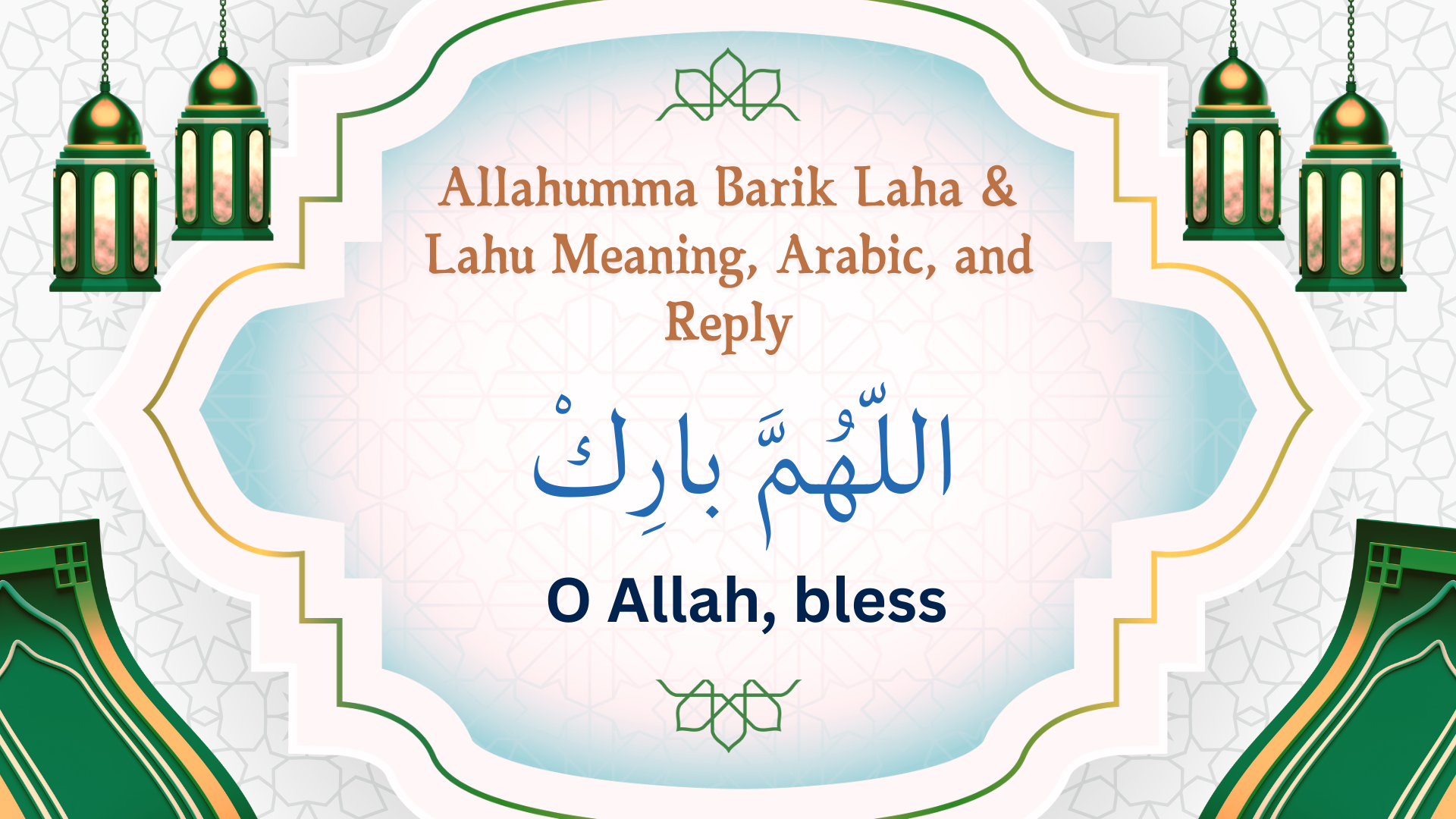
Allahumma Barik Laha & Lahu Meaning, Arabic, and Reply

Allahumma Barik Laha In Islam, many phrases carry deep meanings that go beyond their literal translation.

Although it is often said on joyous occasions like marriages, new possessions, and births, its full significance and proper usage are not always well understood by all.

This article explores the meaning and importance of “Allahumma Barik” in Islam, shedding light on how and when to use this beautiful supplication.

Allahumma Barik in Arabic Text

The phrase “Allahumma Barik” is written in Arabic as:

اللّهُـمَّ بارِكْ

Allahumma Barik Meaning in English

“Allahumma Barik” (اللهم بارك) means “O Allah, bless” or “O Allah, shower Your blessings.”

It is a supplication asking Allah to bestow His grace, protection, and prosperity upon something or someone. When using this phrase, you are asking Allah for:

  • Blessings and protection
  • Favor and mercy
  • Abundance and prosperity
  • Grace and kindness

It is often used in situations such as:

  • Expressing gratitude and appreciation
  • Seeking blessings and protection
  • Celebrating happy occasions like weddings, new births, or acquisitions
  • Asking for divine favor and guidance

This phrase holds a deeper meaning than just its translation, as it connects you with Allah while seeking His blessings in all aspects of life.

Allahumma Barik Laha in Arabic

Allahumma Barik Laha

For a female “Allahumma Barik Laha” is written as:

اللّهُـمَّ بارِكْ لَها

Allahumma Barik Laha Meaning in English

“Allahumma Barik laha” translates to “O Allah, bless her.” It is used to request blessings specifically for a female.

Allahumma Barik Lahu in Arabic

Allahumma Barik Lahu

For a male, the phrase is written as:

اللّهُـمَّ بارِكْ لَهُ

Allahumma Barik Lahu Meaning in English

“Allahumma Barik lahu” translates to “O Allah, bless him,” and is used when asking blassings for a male.

How to Reply to Allahumma Barik

When someone says “Allahumma Barik” to you, you can respond with:

  • Ameen (آمين): meaning “May it be so.”
  • JazakAllah Khair: meaning “May Allah reward you with goodness.”
  • BarakAllah Feek (بارك الله فيك): meaning “May Allah bless you too.”

These responses acknowledge the person’s supplication and return the kind gesture by invoking Allah’s blessings upon them.

When to Use Allahumma Barik

“Allahumma Barik” can be used in various scenarios, including:

  1. Celebrating Joyous Occasions:
  • Weddings: “Allahumma Barik upon the newlyweds.”
  • New births: “Allahumma Barik upon the newborn.”
  • New possessions: “Allahumma Barik upon your new home/car.”

2. Expressing Gratitude:

  • “Allahumma Barik for this blessing.”

3. Seeking Blessings:

  • “Allahumma Barik upon our gathering.”

4. Showing Appreciation:

  • “Allahumma Barik for your support.”

5. Asking for Protection:

  • “Allahumma Barik upon our family/community.”

Difference Between Allahumma Barik and Masha Allah

Both “Allahumma Barik” and “Masha Allah” are phrases used in Islam, but they serve different purposes:

  • “Allahumma Barik” means “O Allah, bless” and is used as a supplication to seek Allah’s blessings.
  • “Masha Allah” means “What Allah has willed” and is used to express admiration or appreciation for something good.

While “Allahumma Barik” is a supplication asking for blessings, “Masha Allah” acknowledges that something positive has happened by Allah’s will.

Hadith on Allahumma Barik

Allahumma Barik

There are several hadiths mentioning the phrase “Allahumma Barik,” such as:

Hadith Example: Aqil bin Abu Talib married a woman from Banu Jusham, and people said to him, “May you live in harmony and have many sons.

اللَّهُمَّ بَارِكْ لَهُمْ وَبَارِكْ عَلَيْهِمْ

Meaning:

“O Allah, bless them and bestow blessings upon them.”

Another Hadith:

اللَّهُمَّ بَارِكْ لَنَا فِيهِ وَأَطْعِمْنَا خَيْرًا مِنْهُ

Meaning:

“O Allah, bless us in it and provide us with better than it.”

When to Say Allahumma Barik

Muslims to pray for blessings when admiring something about their brothers and sisters.

Saying “Allahumma Barik” wards off harm and brings protection.

As Ibn al Qayyim explains, saying “Allahumma Barik” when admiring something protects against the evil eye.

In summary, “Allahumma Barik” is a beautiful supplication seeking Allah’s blessings. which can be used in various situations to ask for divine grace and protection.

Whether it’s for a joyous occasion or expressing gratitude, it holds great significance in Muslim life.

How Many Pages in Quran? Facts, and the Story of Its Revelation

The Quran, the holy book of Islam, was revealed to the Prophet Muhammad (ﷺ). A common question asked is: How many pages are in the Quran?

How many pages are in the Quran?

The answer varies depending on several factors such as font size, page dimensions, line spacing, and margins, among others. A typical Arabic-only Quran usually spans around 600-610 pages.

When translations are included, the number of pages can double, and if the text includes both Arabic and translation along with tafsir (exegesis) and relevant hadiths or commentary, the number can quadruple.

However, the Arabic-only version remains the most popular among Muslims, who frequently read it for spiritual rewards.

As narrated by Abdullah bin Mas’ud, the Prophet Muhammad (ﷺ) said:

“Whoever recites a letter from Allah’s Book receives a reward, and that reward is multiplied tenfold. I do not say that Alif Lam Mim is one letter, but Alif is a letter, Lam is a letter, and Mim is a letter.” (Jami` at-Tirmidhi 2910)

Facts about the Quran:

The Quran contains many fascinating details and signs, as mentioned in Surah Al Imran, Verse 190:

Indeed, in the creation of the heavens and the earth, and the alternation of night and day, are signs for those of understanding.

Here are some key facts about the Quran:

  • The Quran consists of 114 Surahs (chapters) and 30 Juz (sections).
  • It was revealed over a period of 23 years.
  • 82 Surahs were revealed in Makkah (before the Prophet’s ﷺ migration to Medina), while 32 Surahs were revealed in Medina.
  • The longest Surah is Al-Baqarah, and the shortest is Al-Kausar.
  • 25 prophets are mentioned in the Quran, with Prophet Musa (A.S) being mentioned the most (136 times).
  • The first revelation occurred in the month of Ramadan, and the final revelation was in Dhul-Hijjah.
  • There are 14 verses of prostration (Sujood) and 558 sections (Ruku’) in the Quran.
  • Surah Tauba does not begin with “Bismillah,” while Surah Naml contains “Bismillah” twice, resulting in a total of 114 occurrences of “Bismillah” in the Quran.
  • The Quran mentions 12 significant battles from the early days of Islam.
  • 16 animals are referenced in the Quran, with the largest being the elephant and the smallest being the mosquito.
  • Prophet Muhammad’s (ﷺ) name is mentioned four times in the Quran, and six Surahs are named after him.
  • The words “man” and “woman” are mentioned equally, both appearing 24 times.
  • Maryam (A.S) is the only woman mentioned by name in the Quran.
  • Zayd bin Harith (R.A) is the only companion (Sahabi) whose name appears in the Quran.

Some Questions and Answers about Quran (FAQs)

How many pages are in the Quran?

A standard Arabic-only Quran contains approximately 600 pages.

How long does it take to read one Juz?

On average, a non-Arabic speaker takes 30-45 minutes to read one Juz (section).

How many days does it take to read the entire Quran?

If someone reads continuously, they can complete the Quran in about two days.

How many pages are there in a Juz?

Each Juz contains around 20 pages.

Does the Quran have 604 pages?

The number of pages in the Quran can vary depending on the publication and the script used. A standard Quran, especially in the Madani Mushaf (the version commonly printed in Saudi Arabia), typically contains 604 pages. However, other versions may have slightly more or fewer pages depending on factors like font size, page dimensions, and layout.

How many pages does a Quran have?

A standard Arabic-only Quran usually has between 600 and 610 pages. However, when translations or commentary (Tafsir) are included, the number of pages can significantly increase.

How many ayat (verses) are in the Quran?

The Quran contains 6,236 ayat (verses), excluding the Bismillah (In the Name of Allah, the Most Gracious, the Most Merciful) at the beginning of each Surah, which is considered a separate verse in some counts. Including Bismillah, the total comes to 6,349 ayat.

Why does the Quran have 114 surahs?

The Quran has 114 surahs (chapters) because this is how it was revealed by Allah through the Angel Jibreel (Gabriel) to Prophet Muhammad (ﷺ). Each surah has a specific message, theme, and purpose, with divine wisdom behind the division into 114 chapters.

How many chapters of the Quran are there?

There are 114 chapters (surahs) in the Quran.

Does the Quran have 30 sections?

Yes, the Quran is divided into 30 sections known as Juz (plural: Ajza). This division is primarily for the convenience of reading, allowing Muslims to complete the entire Quran within a month by reading one Juz per day, particularly during Ramadan.

Is the Quran divided into 114 surahs?

Yes, the Quran is divided into 114 surahs (chapters), each with varying lengths and specific themes or messages.