Category Archives: Quran Verse

Ayatul Kursi with English and Urdu Translation

Ayatul Kursi is the 255th verse of Surah al Baqarah, which is the largest surah of the Quran. This is the best and most powerful Ayat (verse) in the Quran, and a Hadith proves that as well. Ayat al Kursi is a powerful ayat that provides protection, peace, and spiritual benefits.

The Prophet (Peace Be Upon Him) asked a companion, Abu Mundhir, about which verse is the greatest in the Quran. The companion started reciting Ayatul Kursi.

[button color=”primary” size=”medium” link=”https://islampro.net/wp-content/uploads/2025/05/Ayatul-kursi.mp3″]Download Audio[/button] [button color=”primary” size=”medium” link=”https://islampro.net/wp-content/uploads/2025/05/Ayatul-kursi.mp4″]Ayat Kursi Video[/button]

Listen to Ayat Al Kursi Audio

Ayatul Kursi Arabic Text

اللَّهُ لَا إِلَٰهَ إِلَّا هُوَ الْحَيُّ الْقَيُّومُ ۚ لَا تَأْخُذُهُ سِنَةٌ وَلَا نَوْمٌ ۚ لَهُ مَا فِي السَّمَاوَاتِ وَمَا فِي الْأَرْضِ ۗ مَنْ ذَا الَّذِي يَشْفَعُ عِندَهُ إِلَّا بِإِذْنِهِ ۚ يَعْلَمُ مَا بَيْنَ أَيْدِيهِمْ وَمَا خَلْفَهُمْ ۖ وَلَا يُحِيطُونَ بِشَيْءٍ مِّنْ عِلْمِهِ إِلَّا بِمَا شَاءَ ۚ وَسِعَ كُرْسِيُّهُ السَّمَاوَاتِ وَالْأَرْضَ ۖ وَلَا يَئُودُهُ حِفْظُهُمَا ۚ وَهُوَ الْعَلِيُّ الْعَظِيمُ

Ayatul Kursi English Translation:

Allah! There is no deity except Him, the Ever-Living, the Sustainer of [all] existence. Neither drowsiness overtakes Him nor sleep. To Him belongs whatever is in the heavens and whatever is on the earth. Who is it that can intercede with Him except by His permission? He knows what is before them and what will be after them, and they encompass not a thing of His knowledge except for what He wills. His Kursi (throne) extends over the heavens and the earth, and their preservation tires Him not. And He is the Most High, the Greatest.
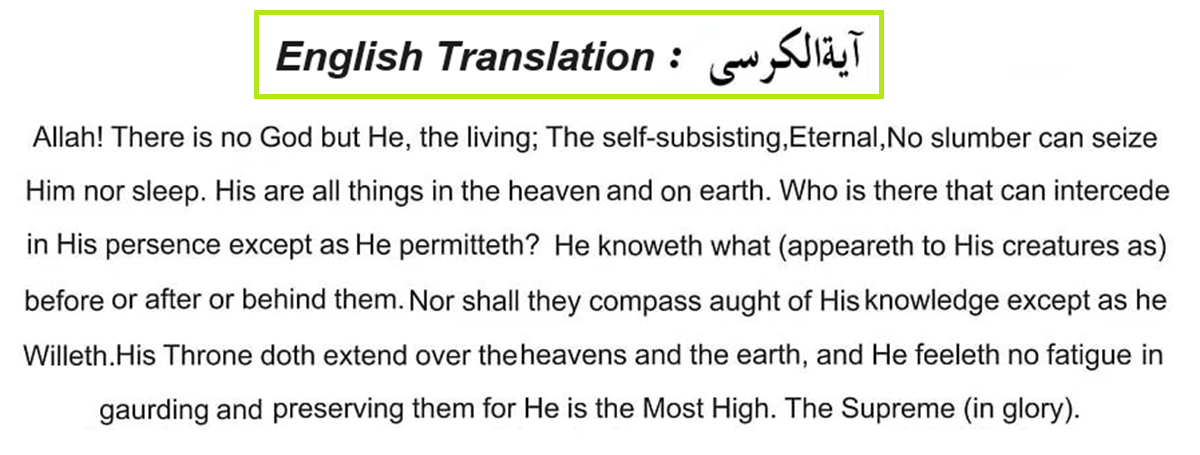
Ayatul Kursi English Translation

Ayatul Kursi Urdu Translation:

اللہ! اس کے سوا کوئی عبادت کے لائق نہیں، وہ زندہ ہے، سب کا تھامنے والا ہے۔ اسے نہ اونگھ آتی ہے نہ نیند۔ اسی کا ہے جو کچھ آسمانوں اور زمین میں ہے۔ کون ہے جو اس کے حضور سفارش کرے بغیر اس کے اذن کے؟ وہ جانتا ہے جو ان کے آگے ہے اور جو ان کے پیچھے ہے اور وہ اس کے علم میں سے کچھ نہیں پاتے مگر جتنا وہ چاہے۔ اس کی کرسی آسمانوں اور زمین کو محیط ہے اور اسے ان کی حفاظت نہیں تھکاتی۔ اور وہی بلند ہے، عظیم ہے۔
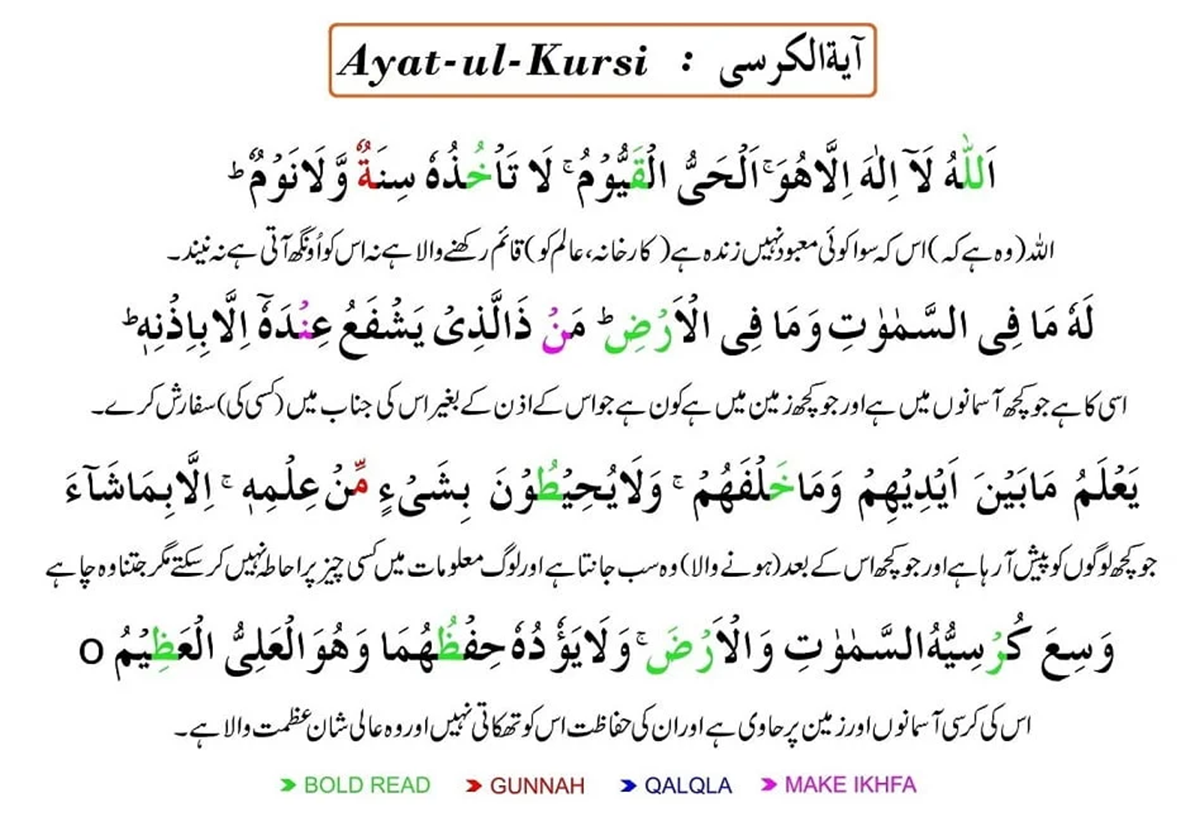
ayatul kursi with urdu translation

Benefits of Reciting Ayatul Kursi

Ayatul Kursi, a verse from the Quran (Surah Al Baqarah, 2:255), is considered one of the most powerful verses. Here are some benefits of reciting Ayat ul Kursi:

  • Ayatul Kursi protects from harm, evil, and danger. Reciting it can safeguard you and your loved ones.
  • It brings tranquility and peace to the heart, reducing stress and anxiety.
  •  Reciting Ayat al Kursi can bring blessings to your home and protect it from negative influences.
  • It can help in overcoming obstacles and challenges in life.
  •  Reciting it strengthens your faith and connection to God.
  •  Reciting it before sleep keeps you safe from nightmares and disturbances.
  • Angels stay with you when you recite Ayatul Kursi, bringing divine protection and blessings.

Ayat Al Kursi Video

Question and Answers (FAQs)

  1. What is Ayatul Kursi?

The “Throne Verse” is verse 255 of Surah Al Baqarah, which describes Allah’s supreme authority and dominion over the heavens and earth.

  1. Why is Ayat Al-Kursi so important in Islam?

Among the most powerful verses in the Qur’an, Ayatul Kursi emphasizes Allah’s eternal existence, His control over all things, and His oneness. Reciting it regularly is also believed to offer protection, blessings, and divine guidance.

  1. What are the benefits of reciting Ayat Al Kursi?

The following are some of the benefits of reciting Ayat al Kursi:

  • An individual is protected from harm by it as it prevents evil and negative forces from entering his or her life.
  • During the night, angels will be appointed to guard the person who recite this prayer before going to sleep.
  • A Hadith states that reciting it after every obligatory prayer ensures entry into Paradise.
  1. Is there a specific time to recite Ayat Al Kursi?

In addition to being able to recite Ayatul Kursi at any time, it is particularly recommended after obligatory prayers, before sleeping, and when seeking protection or blessing.

  1. What did Prophet Muhammad (PBUH) say about reciting Ayatul Kursi?

The Prophet Muhammad (PBUH) said: “Whoever recites Ayatul Kursi after every obligatory prayer, nothing stands between him and Paradise except death.” (Sunan an-Nasa’i 9928). This hadith highlights the immense spiritual value of regularly reciting this verse.

  1. How does Ayatul Kursi offer protection from shayateen (evil forces)?

A narration from Sahih al-Bukhari states that when someone recites Ayat al-Kursi before sleeping, Allah assigns an angel to protect the person throughout the night.

  1. How can reciting Ayatul Kursi bring peace and tranquility?

As a result of affirming Allah’s supremacy and constant oversight, reciting the Ayat al Kursi makes a believer feel secure in his or her protection.
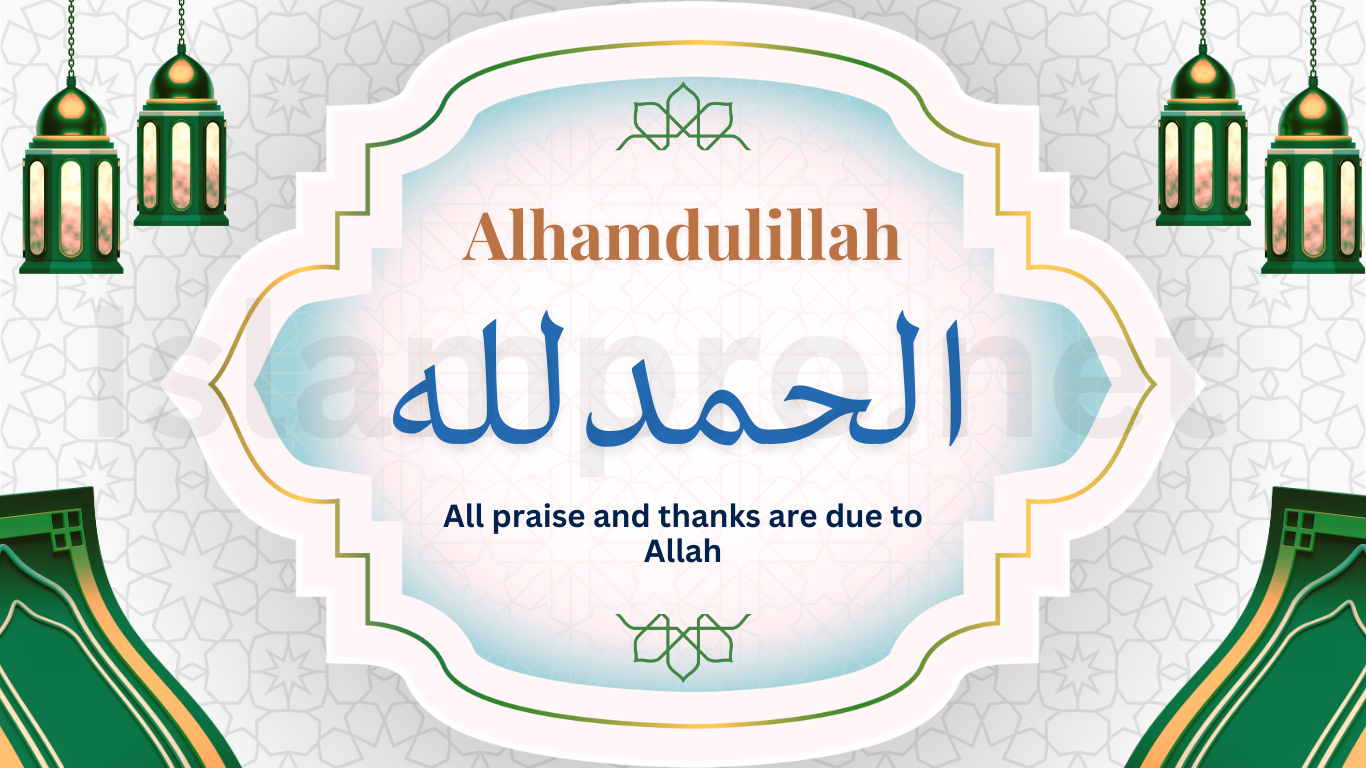
Saying Alhamdulillah for everything invites Blessings into our lives

What is Alhamdulillah in islam

Alhamdulillah“, al-ḥamdu li-llāhi is an Arabic phrase and a part of of surah Fatihah that holds profound significance for Muslims around the world. It translates to “All praise and thanks are due to Allah” and is a powerful expression of gratitude (شكر ) and acknowledgment of Allah’s countless blessings. This simple yet meaningful phrase reminds us to remain thankful in every situation, whether in ease or difficulty.

Alhamdulillah in Arabic with Translation

الْحَمْدُ لِلّٰهِ (al-ḥamdu li-llāhi)

All praise and thanks are due to Allah 

Alhamdulillah for everything arabic

The Importance of Saying Alhamdulillah

Thankfulness is a core value in Islam. By saying “Alhamdulillah” we recognize that every blessing—big or small—comes from Allah. It’s not just a word; it’s an act of worship that strengthens our connection with the Creator.

The Quran emphasizes the importance of gratitude repeatedly. Allah says:

“If you are grateful, I will certainly give you more” Surah Ibrahim Verse 7)

This verse reminds us that expressing gratitude through “Alhamdulillah” invites more blessings into our lives.

Alhamdulillah fills the scales

The Prophet Muhammad (ﷺ) said:

“Purity is half of faith, and ‘Alhamdulillah’ fills the scale, and ‘SubhanAllah and Alhamdulillah’ fill up what is between the heavens and the earth.” (Sahih Muslim, Hadith 223)

This hadith highlights the value of saying “Alhamdulillah” in terms of rewards.

Praising Allah After Eating and Drinking

The Prophet Muhammad (ﷺ) said:

“Allah is pleased with the servant who, after eating food, praises Him and after drinking praises Him.” (Sahih Muslim, Hadith 2734)

This encourages Muslims to say “Alhamdulillah” after every meal as a form of thankfulness.

Alhamdulillah as a Means of Forgiveness

The Prophet Muhammad (ﷺ) said:

“Whoever says, ‘SubhanAllah’ 33 times, ‘Alhamdulillah’ 33 times, and ‘Allahu Akbar’ 34 times at the end of every prayer will have their sins forgiven, even if they are as abundant as the foam of the sea.” (Sahih Muslim, Hadith 597)

This hilights the importance of “Alhamdulillah” as part of the remembrance (dhikr) after prayer.

Saying Alhamdulillah After Sneezing

The Prophet Muhammad (ﷺ) said:

“When one of you sneezes, let him say ‘Alhamdulillah,’ and let his brother or companion say to him, ‘Yarhamuk Allah’ (May Allah have mercy on you).” (Sahih al-Bukhari, Hadith 6224)

This shows that saying “Alhamdulillah” is an act of sunnah after sneezing.

These hadiths shows how saying “Alhamdulillah” is not just a word but a profound act of worship, bringing blessings and forgiveness while strengthening our relationship with Allah.

What is the Meaning of Masha Allah

Alhamdulillah for Everything

During moments of joy, saying “Alhamdulillah” invites Allah’s mercy. During trials, it signifies patience and trust in His wisdom. The phrase “Alhamdulillah for everything” encourages us to adopt a mindset of contentment and resilience, accepting that Allah’s plan is always better for us, even if we do not understand it at the moment.

When to Say Alhamdulillah

  • After blessings: When experiencing success, joy, or good news.
  • In hardships: As a way to stay patient and hopeful.
  • In daily life: For every small mercy, like waking up, eating a meal, or enjoying health.
  • In prayer: During salah, Alhamdulillah is part of Surah Al-Fatiha, recited in every rak’ah.
  • After Sneezing: saying “Alhamdulillah” is an act of sunnah after sneezing.
  • After eating and Drinking: Muslims say “Alhamdulillah” after every meal as a form of thankfulness.

Benefits of Saying Alhamdulillah

  • Brings peace to the heart: Gratitude helps reduce stress and brings contentment.
  • Strengthens faith: It reminds us of Allah’s role in every aspect of life.
  • Invites blessings: As promised in the Quran, gratitude attracts more favors from Allah.

Conclusion

Let’s make “Alhamdulillah” a daily habit, a part of our thoughts, words, and actions. Whether in moments of happiness or challenge, saying “Alhamdulillah for everything” is a beautiful way to express gratitude and stay connected to Allah.

May Allah grant us the ability to always be grateful and increase us in His blessings. Alhamdulillah!

What is the Meaning of Masha Allah

Masha Allah” (ما شاء الله) is an Arabic phrase that translates to “As God has willed” or “What Allah has willed” in English. It is often used by Muslims and Arabic speakers as an expression of admiration, gratitude, or appreciation for something good or beautiful, while acknowledging that all blessings come from Allah.

Common Uses:

  1. To Show Admiration:
    • When someone sees something they admire, like beauty, success, or a good deed, they say “Masha Allah” to acknowledge that it is a blessing from God.
    • Example: “You have a beautiful home, Masha Allah!”
  2. To Avoid Envy or the Evil Eye:
    • Saying “Masha Allah” is believed to protect against the evil eye (negative energy caused by jealousy or envy) by attributing the success or beauty to Allah.
    • Example: “Your child is so intelligent, Masha Allah!”
  3. To Express Gratitude:
    • It can also be used to thank Allah indirectly for His blessings.
    • Example: “Masha Allah, everything went well with the project.”

It is a deeply respectful and spiritual phrase that conveys humility and recognition of Allah’s will in all things.

Subhanallahi Wa Bihamdihi Subhanallahil Azeem Meaning & Importance

The phrases “Subhanallahi wa Bihamdihi” and “Subhanallahil Azeem” carry profound significance in Islam. These short but powerful expressions glorify Allah, acknowledging His greatness and majesty. Reciting them regularly brings immense reward and pleasure from Allah.

In this article, we will explore the meaning of these phrases in English, their Arabic text, related Hadiths, and the many benefits of incorporating them into daily remembrance (zikr).

Meaning of Subhanallahi Wa Bihamdihi Subhanallahil Azeem in English

“Subhanallahi Wa Bihamdihi” means Glory be to Allah, and all praise is due to Him, while “Subhanallahil Azeem” means Glory be to Allah, the Great. Together, these phrases glorify Allah for His greatness, power, and majesty, affirming that nothing can compare to Him in authority, wisdom, or knowledge.

Allah is perfect in His essence and attributes, and these phrases serve as a humble reminder of His exalted status.

Subhanallahi Wa Bihamdihi Subhanallahi in Arabic

Below is the Arabic text of these beautiful phrases:

سُبْحَانَ اللَّهِ وَبِحَمْدِهِ، سُبْحَانَ اللَّهِ العَظِيمِ

Translation

Subhanallahi Wa Bihamdihi Subhanallahil Azeem Translation

It is highly recommended to recite these phrases frequently, as they are beloved to Allah, easy to say, and weigh heavily on the scales of good deeds.

Hadiths on Subhanallahi Wa Bihamdihi Subhanallahi Azeem

Hadith 1:

Abu Hurairah (رضي الله عنه) reported that the Messenger of Allah (ﷺ) said:

“There are two statements that are light on the tongue, heavy on the scales, and are dear to the Merciful: Subhanallahi wa Bihamdihi, Subhanallahi Azeem (Glory be to Allah and all praise is due to Him, glory be to Allah the Great).” [Bukhari (6406, 6682, 7563) and Muslim (2694)]

Hadith 2:

Jabir (رضي الله عنه) reported that the Prophet (ﷺ) said:

“For the one who says Subhanallahil azeem wa bihamdihi (Glory be to Allah, the Magnificent, and all praise is due to Him), a palm tree will be planted for him in Jannah.” [Tirmidhi (3464, 3465), Ibn Hibban (2335)]

Benefits of Reciting

Zikr, or the remembrance of Allah, is a cornerstone of Islamic worship. The renowned scholar Ibn Qayyim (RA), in his book “Al-Waabilus Sayyib,” has outlined over 100 virtues of zikr.

Reciting “Subhanallahi wa Bihamdihi” and “Subhanallahil Azeem” brings several benefits:

  • Repels Shaitan and weakens his influence.
  • Pleases Allah, drawing closer to His mercy.
  • Relieves anxiety and stress, offering peace and comfort to the heart.
  • Increases joy and happiness, filling the heart with light.
  • Strengthens the body and mind, fostering resilience.
  • Brightens the face and heart, reflecting inner serenity.
  • Attracts sustenance, leading to material and spiritual blessings.
  • Deepens love for Allah, strengthening faith and devotion.
  • Profound zikr leads to a deeper connection with Allah, fostering awareness of His presence, recognition of His greatness, and an understanding of His divine attributes.
  • In essence, frequent recitation of these phrases opens the door to Allah’s love, fills life with peace, and ensures success in both this life and the Hereafter.

By making “Subhanallahi wa Bihamdihi Subhanallahi” a regular part of your daily zikr, you not only gain Allah’s favor but also unlock a life filled with blessings, tranquility, and ultimate success.

Innallaha Ma Sabireen Meaning, Significance, and Benefits

The Quranic verse “Innallaha ma Sabireen” (Surah Al-Baqarah 2:153) highlights Allah’s constant support for those who practice patience in times of adversity. This verse reassures believers that Allah is always with those who endure trials with perseverance and steadfastness, guiding and comforting them through the most challenging moments.

Arabic Text “Innallaha Ma Sabireen”

Here is the verse in Arabic:

إِنَّ ٱللَّهَ مَعَ ٱلصَّٰبِرِينَ

Meaning of as Innallaha Ma Sabireen in English

Innallaha Ma as Sabireen means, Indeed, Allah is with the patient.

Quranic Verses of Innallaha Ma As-Sabireen in the Quran

The importance of patience (Sabr) is frequently emphasized in both the Quran and Hadith. The verse Innallaha Ma as-Sabireen is mentioned in Surah Baqarah (2:153).

The full verse reads

يَٰٓأَيُّهَا ٱلَّذِينَ ءَامَنُواْ ٱسۡتَعِينُواْ بِٱلصَّبۡرِ وَٱلصَّلَوٰةِۚ إِنَّ ٱللَّهَ مَعَ ٱلصَّٰبِرِينَ

Translation:
“O you who have believed, seek help through patience and prayer. Indeed, Allah is with the patient. (Surah AlBaqarah 2:153)

Another relevant verse is found in Surah Al-Anfal (8:46):

وَأَطِيعُواْ ٱللَّهَ وَرَسُولَهُۥ وَلَا تَنَٰزَعُواْ فَتَفۡشَلُواْ وَتَذۡهَبَ رِيحُكُمۡۖ وَٱصۡبِرُوٓاْۚ إِنَّ ٱللَّهَ مَعَ ٱلصَّٰبِرِينَ

Translation:
And obey Allah and His Messenger, and do not dispute and [thus] lose courage and [then] your strength would depart; and be patient. Indeed, Allah is with the patient. (Surah Al-Anfal 8:46)

Understanding Sabr in Islam

In Islam, Sabr or patience is a core virtue. Islamic scholars identify three primary forms of patience:

Persisting through the challenges of faith, such as fasting, praying, and fulfilling religious obligations despite difficulties.

Patience in avoiding sinful behavior, Resisting temptations and desires that lead to sinful actions, such as lying, stealing, or engaging in other prohibited activities.

Facing life’s trials with gratitude and trust in Allah’s plan, knowing that hardships are opportunities for spiritual growth.

The Quran advises believers to be patient and endure, as seen in Surah Aal-Imran (3:200):

يَٰٓأَيُّهَا ٱلَّذِينَ ءَامَنُواْ ٱصۡبِرُواْ وَصَابِرُواْ وَرَابِطُواْ وَٱتَّقُواْ ٱللَّهَ لَعَلَّكُمۡ تُفۡلِحُونَ

Translation:
O you who have believed, be patient, persevere, and remain steadfast, and fear Allah so that you may be successful. (Surah Aal-Imran 3:200)

Virtues of Patience (Sabr)

Patience is regarded as an unyielding force in Islam. Allah promises that those who are patient will receive reward without limit, and He is always with those who remain steadfast. The Prophet Muhammad (peace be upon him) also taught that patience brings victory, relief, and ease after hardship.

Allah’s guidance for the patient is clear in multiple Quranic verses, including:

Surah Ale Imran (3:120)

But if you are patient and conscious of Allah, their plot will not harm you at all. Indeed, Allah is all-encompassing of what they do.

Surah Yusuf (12:90)

Indeed, he who fears Allah and is patient, then Allah will not allow the reward of those who do good to be lost.

Surah Al Baqarah (2:155-157)

But give glad tidings to those who patiently endure. Who, when disaster strikes them, say, ‘Indeed we belong to Allah, and indeed to Him we will return.

Quranic Verses on the Virtues of Patience

The Quran repeatedly highlights the virtues of patience. Allah loves those who exhibit patience, grants them success, and promises Paradise as a reward for their perseverance:

Surah Al-Mu’minun (23:111)

Indeed, I have rewarded them this Day for their patience; they are indeed victorious.

Surah Al-Shura (42:43)

And whoever is patient and forgives – indeed, that is of the matters [requiring] determination.

Hadiths on the Virtues of Patience

The Prophet Muhammad (peace be upon him) often emphasized the importance of patience in his teachings:

Sahih Bukhari (1496)

The Messenger of Allah said, ‘Whoever is patient, Allah will grant him patience, and no one is given a blessing better and greater than patience.

Sahih Muslim (2999)

How wonderful is the case of a believer! There is good for him in everything, and this applies only to a believer. If prosperity comes to him, he expresses gratitude to Allah, and that is good for him. And if adversity befalls him, he endures it patiently, and that is better for him.”

Conclusion

The verse “Innallaha Ma Sabireen” serves as a powerful reminder for Muslims to remain patient in all circumstances, with the assurance that Allah’s help and blessings will be with those who persevere.

Arabic Calligraphy Innallaha Ma Sabireen

Allah ma sabireen in allah ma sabireen in arabic in allah ma sabireen Inna Allaha Ma Sabireen inna la ma sabireen in arabic innallaha ma as sabireen arabic text innallaha ma as sabireen in arabic calligraphy innallaha ma as sabireen in arabic innallaha ma as sabirin Innallaha Ma as-Sabireen innallaha ma sabireen innallaha ma sabireen arabic text

Innallaha Ma Sabireen

innallaha-ma-sabireen