Allah Hafiz vs Khuda Hafiz | Meaning, Differences, and Proper Use

Allah Hafiz” is a phrase used predominantly in South Asia, particularly among Muslims. Allah Hafiz means “May God protect you” or “God be your protector”.

The word “Allah” refers to God in Arabic, and “Hafiz” means “protector” or “guardian.” So, Allah Hafiz’s meaning is: May Allah Protect you.

It is often used as a farewell phrase, expressing a wish for God’s protection over someone who is departing.

Allah Hafiz” is a phrase used to wish someone well or bid farewell. It means saying “take care” or “goodbye” with a sense of divine protection. People say it in different situations, like when someone leaves or before starting a journey, to wish them safety and blessings from God:

Various Ways ‘Allah Hafiz’ is Used in Everyday Life

1. Farewells

It is often used when parting ways with someone, similar to saying “Goodbye” or “Take care,” but with a spiritual dimension. For example, when leaving a friend or family member, one might say, “Allah Hafiz, see you soon.”

2. Ending Conversations

It can be used to end phone conversations, online chats, or any interaction where you are bidding farewell. For instance, “Alright, I have to go now. Allah Hafiz!

3. Expressing Concern

When someone is about to undertake a journey or face a challenging situation, “Allah Hafiz” can be used to express your concern and wish for their safety. For example, “You’re traveling tomorrow? Allah Hafiz, have a safe trip.”

4. After Prayers

It can be said after prayers or religious gatherings as a way of extending the blessings of the occasion. For example, after a group prayer, you might hear, “Allah Hafiz, everyone.”

5. Cultural Greetings

In some cultures, “Allah Hafiz” is used more broadly in social contexts, even beyond close relationships, as a respectful and caring way to end an interaction.

6. Letters and Messages

It is often used at the end of letters, emails, or messages, similar to how “Sincerely” or “Best regards” might be used in English. For example, “Thank you for your help. Allah Hafiz,”

Saying Allah Hafiz adds a special spiritual and cultural meaning to the conversation, showing that you wish for God’s care and protection for the person you are talking to.

Differences between Khuda Hafiz and Allah Hafiz

Khuda Hafiz and Allah Hafiz are ways to say goodbye with a blessing for God’s protection. They have some differences because of language and culture

Language Origin

  • Khuda Hafiz: “Khuda” is a Persian word for God. “Hafiz” is an Arabic word meaning protector or guardian. This phrase is more commonly used in Iran, Afghanistan, and parts of India and Pakistan, where Persian influence is significant.
  • Allah Hafiz: “Allah” is the Arabic word for God, and “Hafiz” means protector. This phrase is widely used in Arab-speaking countries and has become more popular in South Asia in recent years due to a shift towards using Arabic terms in religious contexts.

Cultural and Regional Usage

  • Khuda Hafiz: Traditionally used in Urdu-speaking regions, including India and Pakistan. It reflects a blend of Persian and Urdu linguistic traditions.
  • Allah Hafiz: Gained popularity in the same regions as a reflection of a growing emphasis on Arabic, particularly in religious contexts. This shift is partly influenced by an increased focus on using the Arabic name for God.

Religious Connotations

  • Khuda Hafiz: While it has strong Islamic connotations, it is also used more broadly among people of different faiths in Persian-speaking regions.
  • Allah Hafiz: Specifically emphasizes Islamic identity, as “Allah” is directly associated with the Islamic conception of God.

Modern Trends

  • Khuda Hafiz: Although still in use, especially among older generations and in literary contexts, its usage is gradually being overshadowed by “Allah Hafiz.”
  • Allah Hafiz: More commonly used in contemporary times, especially among younger generations and in contexts emphasizing Islamic terminology.

What is reply of Khuda Hafiz and Allah Hafiz

The reply to both “Khuda Hafiz” and “Allah Hafiz” is often the same, reflecting the same wish for divine protection and well-being. Common replies include:

Khuda Hafiz

  • Khuda Hafiz: same phrase as a reciprocal response
  • Allah Hafiz: if the speaker prefers the Arabic term
  • Fi Amanillah: meaning “In the protection of Allah”
  • Take care: less formal, more universal)

Allah Hafiz

  • Allah Hafiz: Same phrase as a reciprocal response
  • Khuda Hafiz: If the speaker prefers the Persian term
  • Fi Amanillah: meaning “In the protection of Allah”
  • Take care:  less formal, more universal

These replies all convey a mutual wish for the other person’s safety and well-being, aligning with the spiritual and protective nature of the original phrases.

In summary, both phrases serve the same purpose of wishing divine protection, but “Khuda Hafiz” has a Persian influence and broader cultural usage, while “Allah Hafiz” reflects a more direct Arabic influence and is increasingly preferred in modern Islamic contexts.

Ayatul Kursi with English and Urdu Translation

Ayatul Kursi is the 255th verse of Surah al Baqarah, which is the largest surah of the Quran. This is the best and most powerful Ayat (verse) in the Quran, and a Hadith proves that as well. Ayat al Kursi is a powerful ayat that provides protection, peace, and spiritual benefits.

The Prophet (Peace Be Upon Him) asked a companion, Abu Mundhir, about which verse is the greatest in the Quran. The companion started reciting Ayatul Kursi.

[button color=”primary” size=”medium” link=”https://islampro.net/wp-content/uploads/2025/05/Ayatul-kursi.mp3″]Download Audio[/button] [button color=”primary” size=”medium” link=”https://islampro.net/wp-content/uploads/2025/05/Ayatul-kursi.mp4″]Ayat Kursi Video[/button]

Listen to Ayat Al Kursi Audio

Ayatul Kursi Arabic Text

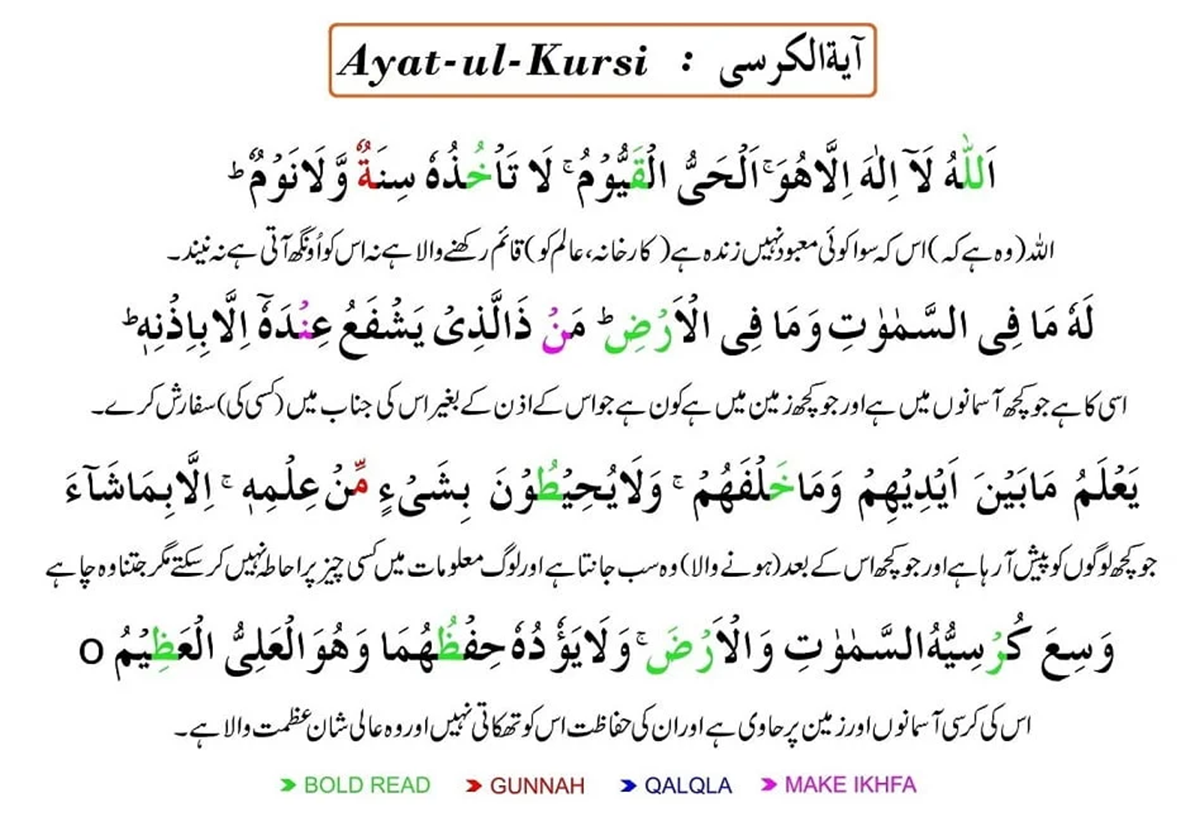
اللَّهُ لَا إِلَٰهَ إِلَّا هُوَ الْحَيُّ الْقَيُّومُ ۚ لَا تَأْخُذُهُ سِنَةٌ وَلَا نَوْمٌ ۚ لَهُ مَا فِي السَّمَاوَاتِ وَمَا فِي الْأَرْضِ ۗ مَنْ ذَا الَّذِي يَشْفَعُ عِندَهُ إِلَّا بِإِذْنِهِ ۚ يَعْلَمُ مَا بَيْنَ أَيْدِيهِمْ وَمَا خَلْفَهُمْ ۖ وَلَا يُحِيطُونَ بِشَيْءٍ مِّنْ عِلْمِهِ إِلَّا بِمَا شَاءَ ۚ وَسِعَ كُرْسِيُّهُ السَّمَاوَاتِ وَالْأَرْضَ ۖ وَلَا يَئُودُهُ حِفْظُهُمَا ۚ وَهُوَ الْعَلِيُّ الْعَظِيمُ

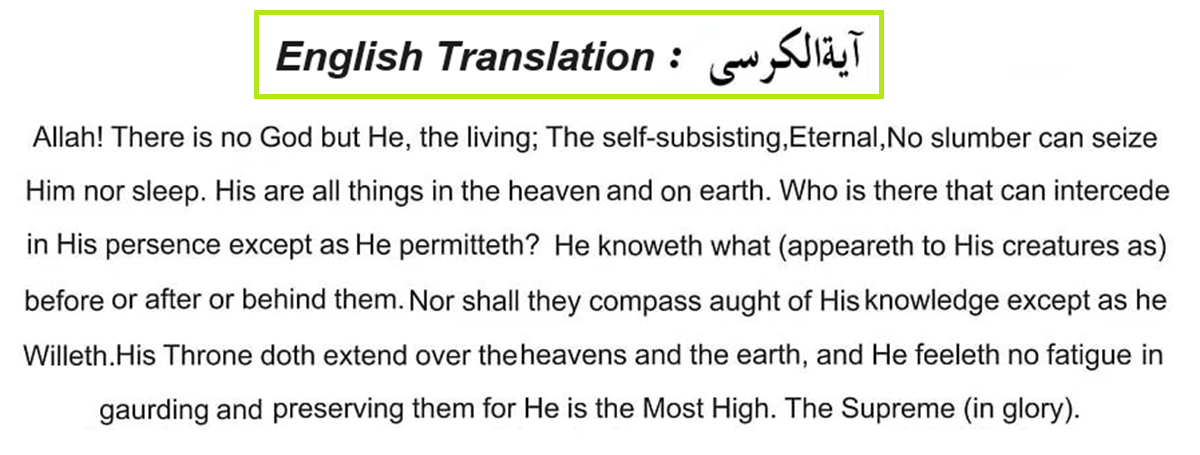
Ayatul Kursi English Translation:

Allah! There is no deity except Him, the Ever-Living, the Sustainer of [all] existence. Neither drowsiness overtakes Him nor sleep. To Him belongs whatever is in the heavens and whatever is on the earth. Who is it that can intercede with Him except by His permission? He knows what is before them and what will be after them, and they encompass not a thing of His knowledge except for what He wills. His Kursi (throne) extends over the heavens and the earth, and their preservation tires Him not. And He is the Most High, the Greatest.

Ayatul Kursi English Translation

Ayatul Kursi Urdu Translation:

اللہ! اس کے سوا کوئی عبادت کے لائق نہیں، وہ زندہ ہے، سب کا تھامنے والا ہے۔ اسے نہ اونگھ آتی ہے نہ نیند۔ اسی کا ہے جو کچھ آسمانوں اور زمین میں ہے۔ کون ہے جو اس کے حضور سفارش کرے بغیر اس کے اذن کے؟ وہ جانتا ہے جو ان کے آگے ہے اور جو ان کے پیچھے ہے اور وہ اس کے علم میں سے کچھ نہیں پاتے مگر جتنا وہ چاہے۔ اس کی کرسی آسمانوں اور زمین کو محیط ہے اور اسے ان کی حفاظت نہیں تھکاتی۔ اور وہی بلند ہے، عظیم ہے۔

ayatul kursi with urdu translation

Benefits of Reciting Ayatul Kursi

Ayatul Kursi, a verse from the Quran (Surah Al Baqarah, 2:255), is considered one of the most powerful verses. Here are some benefits of reciting Ayat ul Kursi:

  • Ayatul Kursi protects from harm, evil, and danger. Reciting it can safeguard you and your loved ones.
  • It brings tranquility and peace to the heart, reducing stress and anxiety.
  •  Reciting Ayat al Kursi can bring blessings to your home and protect it from negative influences.
  • It can help in overcoming obstacles and challenges in life.
  •  Reciting it strengthens your faith and connection to God.
  •  Reciting it before sleep keeps you safe from nightmares and disturbances.
  • Angels stay with you when you recite Ayatul Kursi, bringing divine protection and blessings.

Ayat Al Kursi Video

Question and Answers (FAQs)

  1. What is Ayatul Kursi?

The “Throne Verse” is verse 255 of Surah Al Baqarah, which describes Allah’s supreme authority and dominion over the heavens and earth.

  1. Why is Ayat Al-Kursi so important in Islam?

Among the most powerful verses in the Qur’an, Ayatul Kursi emphasizes Allah’s eternal existence, His control over all things, and His oneness. Reciting it regularly is also believed to offer protection, blessings, and divine guidance.

  1. What are the benefits of reciting Ayat Al Kursi?

The following are some of the benefits of reciting Ayat al Kursi:

  • An individual is protected from harm by it as it prevents evil and negative forces from entering his or her life.
  • During the night, angels will be appointed to guard the person who recite this prayer before going to sleep.
  • A Hadith states that reciting it after every obligatory prayer ensures entry into Paradise.
  1. Is there a specific time to recite Ayat Al Kursi?

In addition to being able to recite Ayatul Kursi at any time, it is particularly recommended after obligatory prayers, before sleeping, and when seeking protection or blessing.

  1. What did Prophet Muhammad (PBUH) say about reciting Ayatul Kursi?

The Prophet Muhammad (PBUH) said: “Whoever recites Ayatul Kursi after every obligatory prayer, nothing stands between him and Paradise except death.” (Sunan an-Nasa’i 9928). This hadith highlights the immense spiritual value of regularly reciting this verse.

  1. How does Ayatul Kursi offer protection from shayateen (evil forces)?

A narration from Sahih al-Bukhari states that when someone recites Ayat al-Kursi before sleeping, Allah assigns an angel to protect the person throughout the night.

  1. How can reciting Ayatul Kursi bring peace and tranquility?

As a result of affirming Allah’s supremacy and constant oversight, reciting the Ayat al Kursi makes a believer feel secure in his or her protection.

Mindful Remembrance: Creative Ways to Teach Dhikr to Kids

We as Muslims remember Allah every day. We recite the Quran and offer supplications. All of these practices combined help us to stay in touch with our creator and this is what is referred to as Dhikr.

Grown adults do not find it difficult to perform dhikr every day. On the other hand, young children need to learn how to perform these very basic practices. Many question why we need to perform dhikr and how they do it. It is important to teach them that Dhikr is remembering Allah by thanking him and offering prayers. It is a practice that helps to ground the children and make them stay connected to religion.

In this article, we will discuss how you can encourage your child to bring dhikr into their lives.

What Phrases Are Included in Daily Dhikr?

Various islamic terms are frequently used in our daily Islamic practice. Muslims often say simple words regularly; for example, every time we wish to show thankfulness and gratitude, we say Alhamdulillah. Similarly, various phrases are incorporated into our daily lives.

A few examples of these terms include “In sha Allah,” “Ma sha Allah,” “Tawakkaltu Alallah,” and so on. It is important for every Muslim, whether adult or child, to know the meaning behind these terms and when to use them in their daily worldly activities.

Creative Ways to Teach Dhikr to Kids

The traditional practices of teaching Dhikr to kids have become old-fashioned and repetitive. These days, children want something engaging and exciting to keep them hooked:

1.    A Dhikr Circle

As the name states, A dhikr circle consists of children sitting in a circle. The dhikr circle will look quite intriguing to the kids as they will think of it as a game. Once you gather all the children in one place, ask each child to say a little dhikr. It does not have to be complex. You can start by using simple words such as Subhan Allah Alhamdulillah or even Allahu Akbar.

You can even add actions to add some more fun to the practice. For example, the children can place a hand on their heart every time they say Alhamdulillah. Such sensory approaches help the kids to form a physical as well as emotional connection to the daily dhikr. The circle can end when every child has had their turn. You can then recite a dua that will signify the end of the activity.

2.    Bead Craft

Kids, especially girls, love doing arts and crafts. For a bead craft, you can again gather up children in a room. Make them engage by helping them create their own dhikr craft beads or a tasbih. They can color each of the beads differently and you can tell them that each color represents a dhikr. Kids always love to play with their own creations.

Once all the children complete the tasbih, you can teach them what each color means. For example, you can say red means Subhan Allah and purple means Allahu Akbar. The children can even decorate their dhikr tasbih however they like. They can add charms or flowers to the tasbih to give a personal touch. Creating an object that they have put their heart into will be a physical reminder that they need to say their daily adhkar regularly.

3.    Storytelling

Children love to listen to stories especially if you tell these stories in a fun way by adding physical actions. There are several names of Allah that hold special meaning behind them. For example, you can take the name Al Rahman, which means the merciful. You can then make up a story about someone’s generosity and then ask them which names of Allah the story represents. The child who guesses it correctly can get a small token of appreciation. Such practices will encourage the children to memorize their daily dhikr.

Every time you tell the kids a story, you can also ask them how they feel about it or if they have any questions about it. Such engaging and interactive sessions help the child stay focused. These practices also encourage them to incorporate the adhkar into their daily practical lives.

4.    Art Classes

Art is one of the best forms of expression not only for adults but children as well. An art and craft class is a mindful and engaging way through which the children can learn things easily. You can allow them to paint, draw, or even write the daily dhikr. They can learn how to do calligraphy or create a collage of several phrases altogether.

The children can also participate in a group activity where each child gets to write what every dhikr means to them. For example, you can use Alhamdulillah and ask them to draw what they are thankful for. Art and crafts are a beautiful way to remind the children that they need to recite these words daily.

5.    Nature Walks

Nothing is better than taking the children on a nature walk and showing them the wonders of Allah. Teach them how every leaf, flower and every part of the world functions in a certain way all by themselves. Seeing and appreciating the beauty of nature will surely make them remember how they perform dhikr in their daily lives.

Teach them to say Alhamdulillah every time they feel the rain or see the sun and Allahu Akbar every time they see something amazing. These activities help the children form a connection with Allah. After you end the walk, the children can gather in a circle and tell everyone how they feel.

6.    Challenge Charts

Just like every school teacher uses sticker charts to promote good behavior in their class, you can use challenge charts to encourage the children to remember Allah. All you need to do is create a chart with all the phrases on it. Every time a child uses the phrase in their practical life, they can paste a sticker on it.

The children can then get especially rewards for completing the chart. Such a routine will help the children to add these important phrases to their daily lives. They will also form a strong positive association with Allah through this engaging activity.

Conclusion

Teaching dhikr to children does not always have to be boring and dull. Teachers and parents should understand that children these days do not like to simply learn stuff over and over again. They need activities that engage them and add a fun twist to the learning routine.

Activities such as arts and crafts, storytelling, nature strolls, etc., are just a few ways through which you can teach your children the importance of these phrases. Teaching these mindful activities will help you create a strong foundation in your everyday life. Moreover, they will surely continue these practices once they grow up. Always remind them that Dhikr is more than just a daily obligation to fulfill. It is a source of peace and thankfulness.

Saying Alhamdulillah for everything invites Blessings into our lives

What is Alhamdulillah in islam

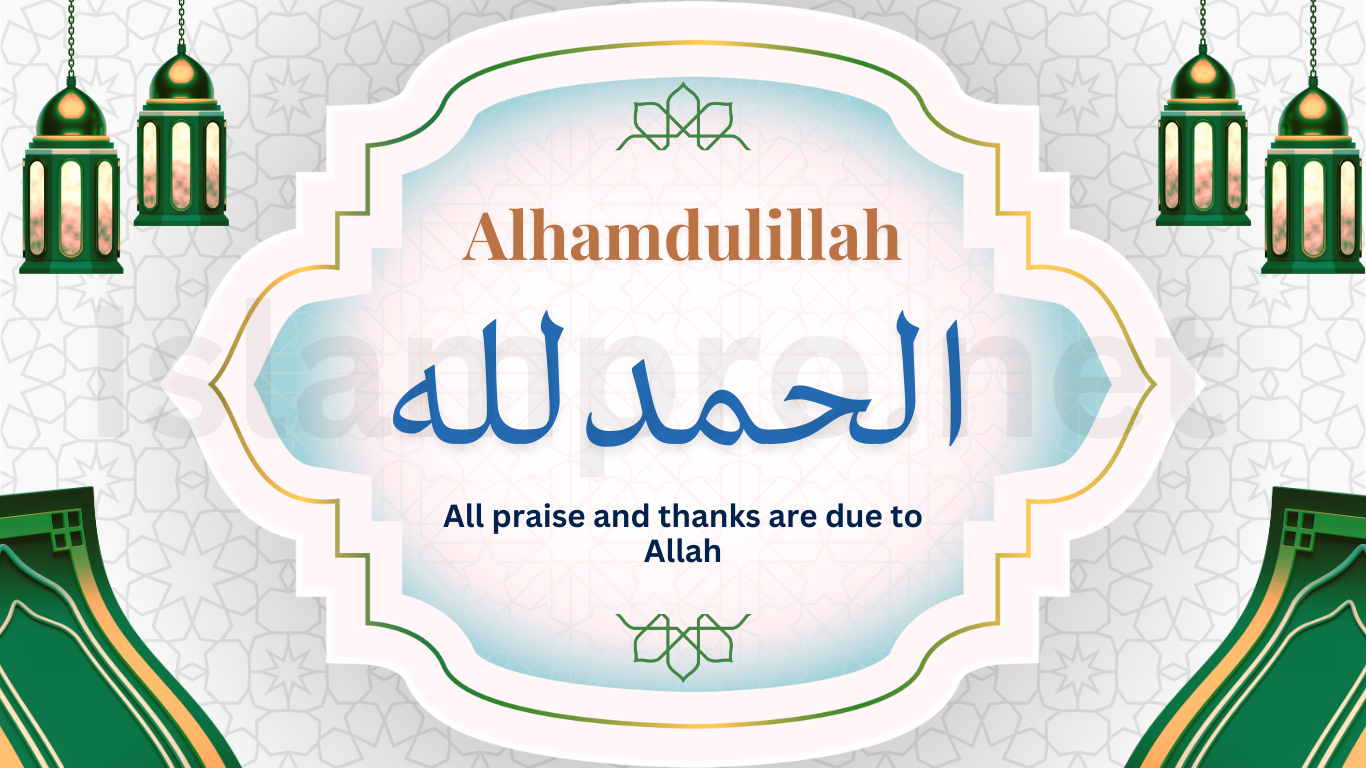
Alhamdulillah“, al-ḥamdu li-llāhi is an Arabic phrase and a part of of surah Fatihah that holds profound significance for Muslims around the world. It translates to “All praise and thanks are due to Allah” and is a powerful expression of gratitude (شكر ) and acknowledgment of Allah’s countless blessings. This simple yet meaningful phrase reminds us to remain thankful in every situation, whether in ease or difficulty.

Alhamdulillah in Arabic with Translation

الْحَمْدُ لِلّٰهِ (al-ḥamdu li-llāhi)

All praise and thanks are due to Allah 

Alhamdulillah for everything arabic

The Importance of Saying Alhamdulillah

Thankfulness is a core value in Islam. By saying “Alhamdulillah” we recognize that every blessing—big or small—comes from Allah. It’s not just a word; it’s an act of worship that strengthens our connection with the Creator.

The Quran emphasizes the importance of gratitude repeatedly. Allah says:

“If you are grateful, I will certainly give you more” Surah Ibrahim Verse 7)

This verse reminds us that expressing gratitude through “Alhamdulillah” invites more blessings into our lives.

Alhamdulillah fills the scales

The Prophet Muhammad (ﷺ) said:

“Purity is half of faith, and ‘Alhamdulillah’ fills the scale, and ‘SubhanAllah and Alhamdulillah’ fill up what is between the heavens and the earth.” (Sahih Muslim, Hadith 223)

This hadith highlights the value of saying “Alhamdulillah” in terms of rewards.

Praising Allah After Eating and Drinking

The Prophet Muhammad (ﷺ) said:

“Allah is pleased with the servant who, after eating food, praises Him and after drinking praises Him.” (Sahih Muslim, Hadith 2734)

This encourages Muslims to say “Alhamdulillah” after every meal as a form of thankfulness.

Alhamdulillah as a Means of Forgiveness

The Prophet Muhammad (ﷺ) said:

“Whoever says, ‘SubhanAllah’ 33 times, ‘Alhamdulillah’ 33 times, and ‘Allahu Akbar’ 34 times at the end of every prayer will have their sins forgiven, even if they are as abundant as the foam of the sea.” (Sahih Muslim, Hadith 597)

This hilights the importance of “Alhamdulillah” as part of the remembrance (dhikr) after prayer.

Saying Alhamdulillah After Sneezing

The Prophet Muhammad (ﷺ) said:

“When one of you sneezes, let him say ‘Alhamdulillah,’ and let his brother or companion say to him, ‘Yarhamuk Allah’ (May Allah have mercy on you).” (Sahih al-Bukhari, Hadith 6224)

This shows that saying “Alhamdulillah” is an act of sunnah after sneezing.

These hadiths shows how saying “Alhamdulillah” is not just a word but a profound act of worship, bringing blessings and forgiveness while strengthening our relationship with Allah.

What is the Meaning of Masha Allah

Alhamdulillah for Everything

During moments of joy, saying “Alhamdulillah” invites Allah’s mercy. During trials, it signifies patience and trust in His wisdom. The phrase “Alhamdulillah for everything” encourages us to adopt a mindset of contentment and resilience, accepting that Allah’s plan is always better for us, even if we do not understand it at the moment.

When to Say Alhamdulillah

  • After blessings: When experiencing success, joy, or good news.
  • In hardships: As a way to stay patient and hopeful.
  • In daily life: For every small mercy, like waking up, eating a meal, or enjoying health.
  • In prayer: During salah, Alhamdulillah is part of Surah Al-Fatiha, recited in every rak’ah.
  • After Sneezing: saying “Alhamdulillah” is an act of sunnah after sneezing.
  • After eating and Drinking: Muslims say “Alhamdulillah” after every meal as a form of thankfulness.

Benefits of Saying Alhamdulillah

  • Brings peace to the heart: Gratitude helps reduce stress and brings contentment.
  • Strengthens faith: It reminds us of Allah’s role in every aspect of life.
  • Invites blessings: As promised in the Quran, gratitude attracts more favors from Allah.

Conclusion

Let’s make “Alhamdulillah” a daily habit, a part of our thoughts, words, and actions. Whether in moments of happiness or challenge, saying “Alhamdulillah for everything” is a beautiful way to express gratitude and stay connected to Allah.

May Allah grant us the ability to always be grateful and increase us in His blessings. Alhamdulillah!

What is the Meaning of Masha Allah

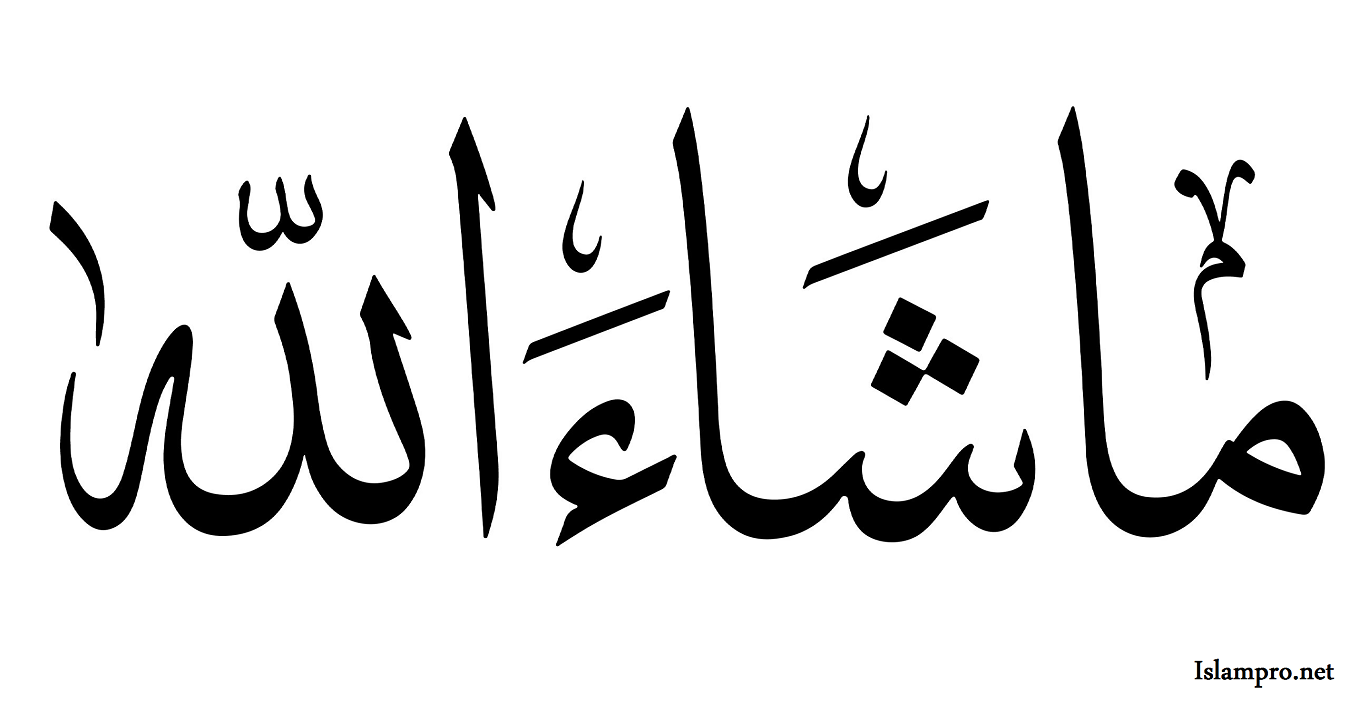
Masha Allah” (ما شاء الله) is an Arabic phrase that translates to “As God has willed” or “What Allah has willed” in English. It is often used by Muslims and Arabic speakers as an expression of admiration, gratitude, or appreciation for something good or beautiful, while acknowledging that all blessings come from Allah.

Common Uses:

  1. To Show Admiration:
    • When someone sees something they admire, like beauty, success, or a good deed, they say “Masha Allah” to acknowledge that it is a blessing from God.
    • Example: “You have a beautiful home, Masha Allah!”
  2. To Avoid Envy or the Evil Eye:
    • Saying “Masha Allah” is believed to protect against the evil eye (negative energy caused by jealousy or envy) by attributing the success or beauty to Allah.
    • Example: “Your child is so intelligent, Masha Allah!”
  3. To Express Gratitude:
    • It can also be used to thank Allah indirectly for His blessings.
    • Example: “Masha Allah, everything went well with the project.”

It is a deeply respectful and spiritual phrase that conveys humility and recognition of Allah’s will in all things.

What is Hajj In Islam

What is Hajj

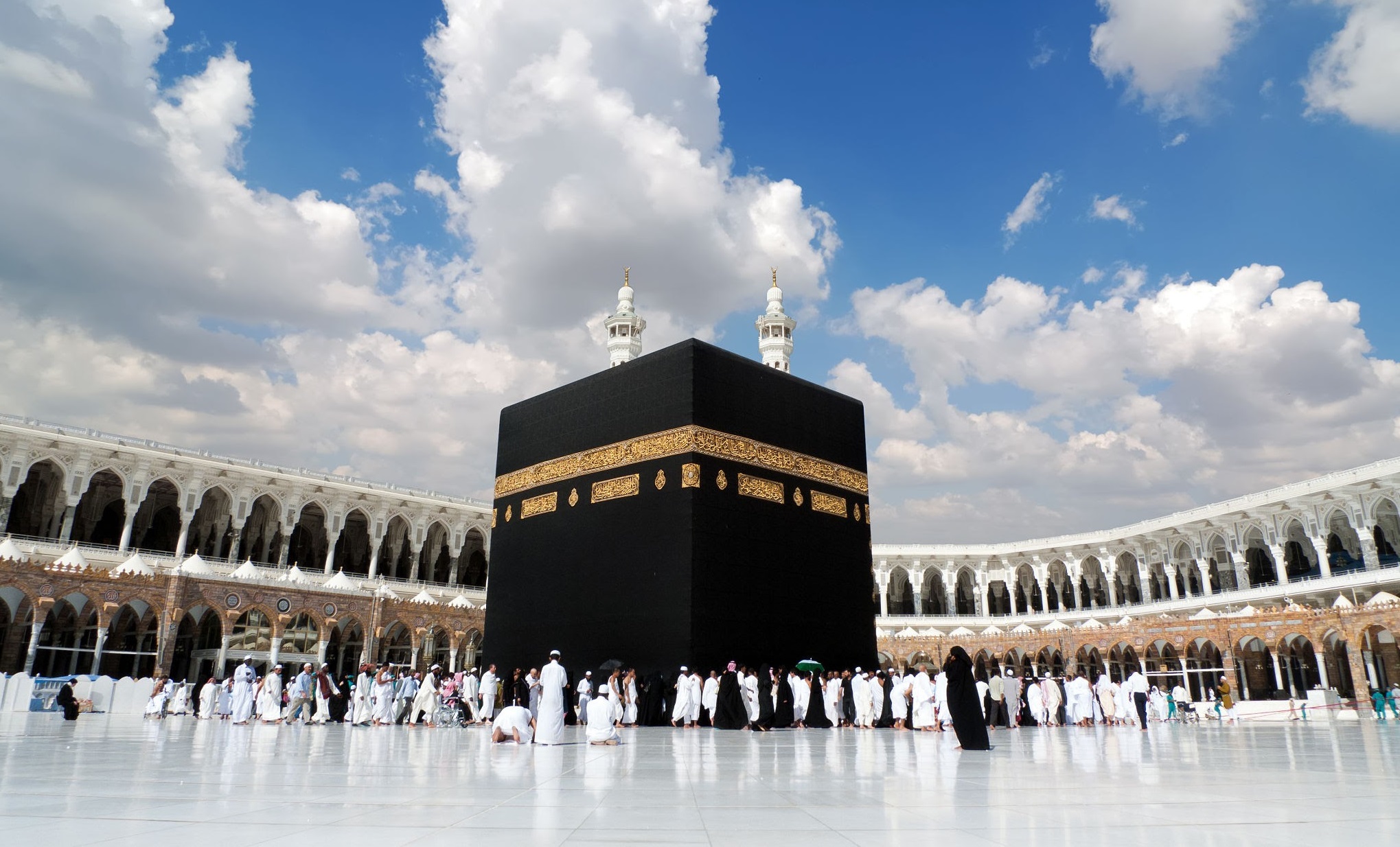
Hajj is one of the five pillars of Islam and represents a mandatory religious pilgrimage to the holy city of Mecca in Saudi Arabia. It is a sacred act of worship that every adult Muslim, who is physically and financially able, is required to perform at least once in their lifetime.

Significance of Hajj

Hajj holds profound spiritual and communal importance in Islam. It is viewed as an opportunity for Muslims to cleanse their sins, renew their faith, and draw closer to Allah. It also emphasizes equality and unity, as all pilgrims wear simple white garments (ihram), erasing distinctions of wealth, status, and nationality.

When and Where?

Hajj is performed annually during the Islamic month of Dhul-Hijjah, specifically from the 8th to the 12th of the month. The focal point of the pilgrimage is the Kaaba, located in the Masjid al-Haram (the Grand Mosque) in Mecca.

Rituals of Hajj

  1. Ihram: Pilgrims enter a state of spiritual purity, wearing special white garments and avoiding certain actions (e.g., arguing, grooming, or engaging in sinful behavior).
  2. Tawaf: Circling the Kaaba seven times in a counter-clockwise direction.
  3. Sa’i: Walking seven times between the hills of Safa and Marwah, commemorating Hagar’s search for water for her son, Ismail.
  4. Arafat: Standing in prayer at Mount Arafat on the 9th of Dhul-Hijjah, which is the pinnacle of Hajj and symbolizes the Day of Judgment.
  5. Muzdalifah: Collecting pebbles for the next ritual and spending the night in prayer and reflection.
  6. Ramy al-Jamarat: Throwing stones at three pillars in Mina, symbolizing the rejection of Satan’s temptations.
  7. Qurbani: Sacrificing an animal (e.g., sheep or goat) to honor Prophet Ibrahim’s willingness to sacrifice his son in obedience to Allah.
  8. Tawaf al-Ifadah: Another circumambulation of the Kaaba, symbolizing deeper submission to Allah.

Outcomes and Spiritual Rewards

After completing the Hajj, Muslims are often honored with the title of “Hajji” and are believed to have their sins forgiven, achieving a spiritual rebirth. It also serves to strengthen the global Muslim community (ummah) through shared worship and experience.

What is Hadith in Islam

The term Hadith refers to the sayings, actions, and approvals of the Prophet Muhammad (peace be upon him). It is one of the primary sources of Islamic teachings and law, second only to the Quran.

Hadiths are classified based on their authenticity, chain of transmission, and content. They are broadly categorized into two main components.

Components of a Hadith

  1. Matn (Text) : The text of the hadith itself, which contains the actual message or teaching.
  2. Isnad (Chain of Narrators) : The chain of narrators who transmitted the hadith. This is important for verifying its authenticity.

Types of Hadith

Hadiths are categorized based on their authenticity:

  1. Sahih (Authentic): Strong and reliable, with a trustworthy chain of narrators.
  2. Hasan (Good): Slightly less reliable than Sahih but still acceptable.
  3. Da’if (Weak): Questionable reliability due to issues in the chain or content.
  4. Mawdu (Fabricated): Not a genuine saying or action of the Prophet.

Most Famous Hadith Collections

The six most recognized collections of Hadith in Sunni Muslims are known as the Kutub al-Sittah (The Six Books) also known as Sihah al-Sitta (الصحاح الستة):

  1. Sahih al-Bukhari: Compiled by Imam al-Bukhari, regarded as the most authentic collection.
  2. Sahih Muslim: Compiled by Imam Muslim, also highly authentic.
  3. Sunan Abu Dawood: A focus on jurisprudential hadith.
  4. Sunan al-Tirmidhi: Includes classifications of authenticity and commentary.
  5. Sunan al-Nasa’i: Known for detailed attention to authenticity.
  6. Sunan Ibn Majah: The last of the six recognized books.


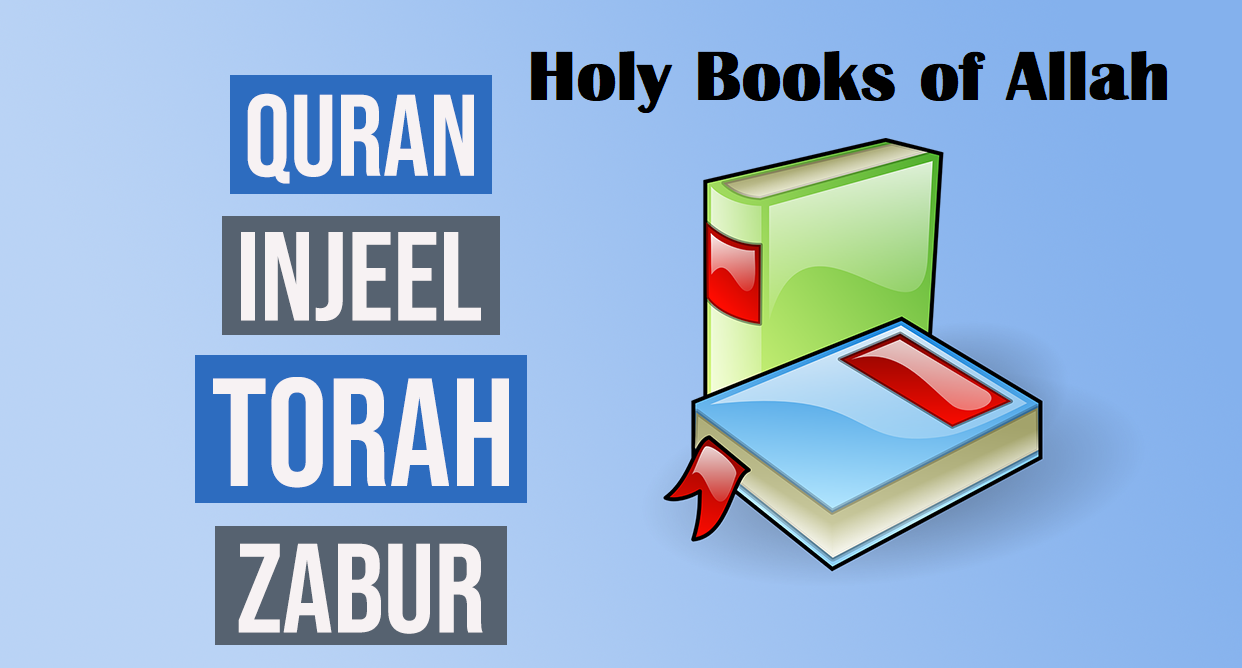
The 4 Holy Books of Prophets | Revealed Books of Allah

There are 4 major books revealed by Allah to different prophets throughout history. These holy books are considered sacred scriptures and are believed to contain divine guidance for humanity. The four holy books, namely the Tawrat, Zabur, Injeel, and Quran, are considered the books of Allah.

The 4 Books of Allah

1. Tawrat (Torah)

The Tawrat, a sacred scripture, was revealed by Allah to Prophet Moses (peace be upon him) as a divine guidance for the Israelites. It contains, and stories that form the foundation of Jewish faith and practice.

2. Zabur (Psalms)

The Zabur, a divine book filled with poetic verses and prayers, was revealed to Prophet David (peace be upon him) as a source of inspiration and guidance.

3. Injeel (Gospel)

The Injeel, a holy book was revealed to Prophet Jesus (peace be upon him) as a divine message for humanity.

4. Quran

The Quran, the final revelation, Quran was revealed to Prophet Muhammad (peace be upon him) as a divine guidance for all of humanity.

The original versions of the Tawrat, Zabur, and Injeel have been corrupted over time. The Quran, however, is believed to be preserved in its original form.

Naat Lyrics | Comprehensive List of Popular Naat Lyrics

introduction

Naat Lyrics is poetry in praise of the Prophet Muhammad (PBUH), commonly recited in Islamic traditions. These devotional songs or recitations are performed across different cultures and languages, often during religious gatherings, on Islamic holidays like Eid Milad-un-Nabi, or even during private prayer times.

Naats inspire love and admiration for the Prophet, and their lyrics often express deep reverence and gratitude for his teachings, character, and sacrifices.

Here is a detailed list of some of the most popular Naat lyrics from various languages, particularly Urdu and Arabic, which are widely recognized in the Muslim world.

1. Tajdar-e-Haram

Language: Urdu
Famous Performer: Sabri Brothers, Atif Aslam
Opening Lyrics: “Tajdar-e-Haram, ho nigaah-e-karam
Hum gareebon ke din bhi sanwar jayenge
Tajdar-e-Haram…”

This is one of the most famous Naats globally, with a rich history, beautifully recited by the Sabri Brothers and reinterpreted by Atif Aslam. The lyrics are a supplication for blessings and mercy, focusing on the grandeur.

The Prophet Muhammad (PBUH) as the leader of the Kaaba and the hope for alleviation of worldly struggles through his intercession.

2. Mera Dil Badal De

Language: Urdu
Famous Performer: Junaid Jamshed
Opening Lyrics: “Mera dil badal de, mera dil badal de
Aisa dil de jo tera ho…”*

A deeply personal and emotional Naat, this was popularized by the late Junaid Jamshed. The lyrics are a heartfelt prayer asking Allah to change one’s heart and guide them toward righteousness through.

The teachings and example of Prophet Muhammad (PBUH). It reflects on personal transformation and the desire for spiritual purity.

  1. Ya Nabi Salam Alaika

Language: Arabic/Urdu
Famous Performer: Maher Zain
Opening Lyrics: “Ya Nabi salam ‘alayka, ya Rasul salam ‘alayka
Ya Habib salam ‘alayka, salawatullah ‘alayka…”

Maher Zain’s version of this famous Naat has garnered a global audience. The lyrics, sung in Arabic and Urdu, are a salute to the Prophet Muhammad (PBUH).

This Naat conveys respect and blessings upon the Prophet, acknowledging his role as a messenger of Allah and offering continuous salutations.

4. Ilahi Teri Chokhat Par

Language: Urdu
Famous Performer: Owais Raza Qadri
Opening Lyrics: “Ilahi teri chokhat par, bhikari ban kay aya hoon
Karam merey Ilahi, karam merey Ilahi…”

This beautiful Naat by Owais Raza Qadri carries deep spiritual meaning. It portrays a sense of humility as the singer places themselves before the divine. Asking for mercy and forgiveness, and acknowledges their dependence on Allah’s grace.

  1. Faslon Ko Takalluf Hai

Language: Urdu
Famous Performer: Amjad Sabri
Opening Lyrics: “Faslon ko takalluf hai hum se agar, hum bhi bay-taab hain
Naat-e-Pak Muhammad ka le kar sadar, qafile chal diye…”

This Naat by Amjad Sabri revolves around the theme of bridging the spiritual distance between the believer and the Prophet Muhammad (PBUH).

It expresses a longing to be close to the Prophet and underscores the timeless nature of his blessings and guidance.

6. Madine Ki Tajalli Se

Language: Urdu
Famous Performer: Hafiz Tahir Qadri
Opening Lyrics: “Madine ki tajalli se, ujala ho gaya dil ka
Tamanna raat din ye hai Madina dekh lo ik din…”

This Naat paints a vivid picture of the spiritual radiance and enlightenment that Madina, the city of the Prophet, brings to a believer’s heart. The lyrics are filled with a yearning to visit Madina and bask in its holiness.

  1. Mustafa Jan-e-Rehmat Pe Lakhon Salam

Language: Urdu
Famous Performer: Hafiz Tahir Qadri
Opening Lyrics: “Mustafa jaane rehmat pe lakhon salaam
Shama-e-bazm-e-hidayat pe lakhon salaam…”

This is a classical Naat, recited by numerous performers over the years. It is a series of salutations (Salaam) offered to the Prophet Muhammad (PBUH), emphasizing his role as a mercy to the world and a guide for humanity.

8. Main To Ummati Hoon

Language: Urdu
Famous Performer: Waheed Zafar Qasmi
Opening Lyrics: “Main to ummati hoon, ummati hoon
Mere Aqa, mera sab kuch hai Madinay wala…”

In this Naat, the singer acknowledges their identity as a follower of the Prophet Muhammad (PBUH). It expresses devotion to the Prophet and highlights the pride and joy of being part of the Ummah (community) that follows his teachings.

9. Karam Maangta Hoon

Language: Urdu
Famous Performer: Owais Raza Qadri
Opening Lyrics: “Karam maangta hoon, Ata maangta hoon
Main tujh se ae Maula Dua maangta hoon…”

This Naat is a beautiful supplication in which the singer asks for divine mercy and blessings from Allah. It’s performed by the highly popular Naat Khawan, Owais Raza Qadri, and reflects humility and a plea for spiritual aid.

10. Balaghal Ula Bi Kamaalihi

Language: Arabic
Famous Performer: Various
Opening Lyrics: “Balaghal ula bi kamaalihi
Kashafad duja bi jamaalihi
Hasunat jami’u khis’alihi
Sallu ‘alayhi wa aalihi…”

This Arabic Naat is a classic, extolling the virtues and beauty of the Prophet Muhammad (PBUH). The lyrics focus on the perfection.

The Prophet’s character and the light he brought into the world, followed by prayers of peace upon him and his family.

Conclusion

Naats play a significant role in Islamic worship and culture, with their heartfelt lyrics reminding believers of the beauty, grace, and virtues of Prophet Muhammad (PBUH).

The list above includes some of the most popular and beloved Naats in Urdu and Arabic, each with its unique message and emotional appeal. Whether in praise, supplication, or expression of love. Naat lyrics continue to inspire generations of Muslims worldwide.

Ramadan Kareem | A Comprehensive Guide to Fasting

Introduction

Ramadan Kareem is the ninth month of the Islamic lunar calendar and is considered the holiest month for Muslims. It is a time of fasting, prayer, reflection, and community.

Fasting during Ramadan Mubarak is one of the Five Pillars of Islam, making it a fundamental aspect of the faith. The exact dates of Ramadan change each year based on the sighting of the moon, but it lasts for 29 or 30 days.

Key Concepts of Ramadan

  1. Fasting (Sawm)

During Ramadan, Muslims fast from dawn (Fajr) until sunset (Maghrib). This means abstaining from eating, drinking, smoking, and sinful behavior during daylight hours.

Fasting serves as a means of spiritual cleansing and is meant to encourage self-discipline, empathy for the less fortunate, and gratitude for one’s blessings.

  • Suhoor: The pre-dawn meal before the fast begins.
  • Iftar: The meal eaten after sunset to break the fast, traditionally with dates and water.

2. Spiritual Growth and Worship

Ramadan Mubarak is not just about physical fasting but also a period of intense spiritual growth. Muslims are encouraged to engage in extra prayers.

Read the Qur’an, and spend more time in reflection. Special nightly prayers called Taraweeh are performed during Ramadan.

  • Quran Recitation: Many Muslims aim to complete the entire Qur’an during Ramadan Mubarak, as it was revealed in this month.
  • Dua (Supplication): Ramadan Mubarak is considered a time when prayers are especially powerful, and Muslims often make special supplications.

3. Charity (Zakat and Sadaqah)

Charity plays a significant role during Ramadan. Giving to the needy is a vital aspect of Muslim life and is emphasized even more during this month.

  • Zakat: An obligatory form of almsgiving, which is a fixed percentage of a Muslim’s savings and wealth. Many choose to pay their Zakat during Ramadan Mubarak to maximize their blessings.
  • Sadaqah: Voluntary charity, which can be given at any time. Ramadan Mubarak is a time when many people give generously to the poor and those in need.

4. The Night of Power (Laylat al-Qadr)

Laylat al-Qadr, or the Night of Power, is believed to be the night when the first verses of the Qur’an were revealed to the Prophet Muhammad (PBUH).

It is considered the holiest night of the year, and prayers during this night are said to be worth more than a thousand months of worship.

Laylat al-Qadr is observed in the last 10 days of Ramadan Mubarak, typically on one of the odd-numbered nights, with the 27th night being most commonly recognized.

Exemptions from Fasting

While fasting is obligatory for all adult Muslims, there are certain exemptions:

  • Children: Not required to fast until they reach puberty.
  • Pregnant and breastfeeding women: Can be exempt if fasting may harm them or their child.
  • The elderly and ill: People with medical conditions that make fasting harmful are not required to fast.
  • Travelers: People who are traveling long distances are allowed to delay their fast and make it up later.
  • Menstruating women: Women experiencing their menstrual cycle are exempt from fasting during this time but must make up for the missed fasts later.

Ramadan Mubarak in Practice

  1. Iftar Traditions

Across the world, Muslims break their fast with a meal called iftar. The meal typically begins with eating dates and drinking water, following the practice of the Prophet Muhammad (PBUH).

Afterward, a more substantial meal is eaten, and family, friends, and communities often gather together for this meal.

2. Ramadan Around the World

While the principles of Ramadan Mubarak are the same globally, cultural practices and traditions vary.

For example:

  • In the Middle East, Iftar is often a large, elaborate feast shared with extended family.
  • In Southeast Asia, markets sell special Ramadan foods, and communal iftar meals are common.
  • In Turkey, people enjoy “Ramazan Pidesi,” a special bread prepared during Ramadan Mubarak.
  1. Eidal-Fitr

At the end of Ramadan, Muslims celebrate Eid al-Fitr, the “Festival of Breaking the Fast.” It is a joyous occasion marked by prayers, feasts, and giving gifts.

Muslims are required to give a special charity known as Zakat al-Fitr before the Eid prayer to ensure that everyone, including the less fortunate, can partake in the celebration.

Conclusion

Ramadan is a sacred and significant month for Muslims around the world. It is a time for personal reflection, spiritual growth, and community bonding.

The practices of fasting, prayer, and charity help Muslims develop self-discipline, compassion, and a stronger connection with God.

Ramadan Mubarak serves as a reminder of the importance of faith and the values of empathy, gratitude, and generosity that transcend this special month.